Yarn & Tools
Essential Notions: The Small Tools Worth Owning
A plain guide to knitting and crochet notions every beginner needs: stitch markers, tapestry needles, row counters, and more small tools that earn their keep.
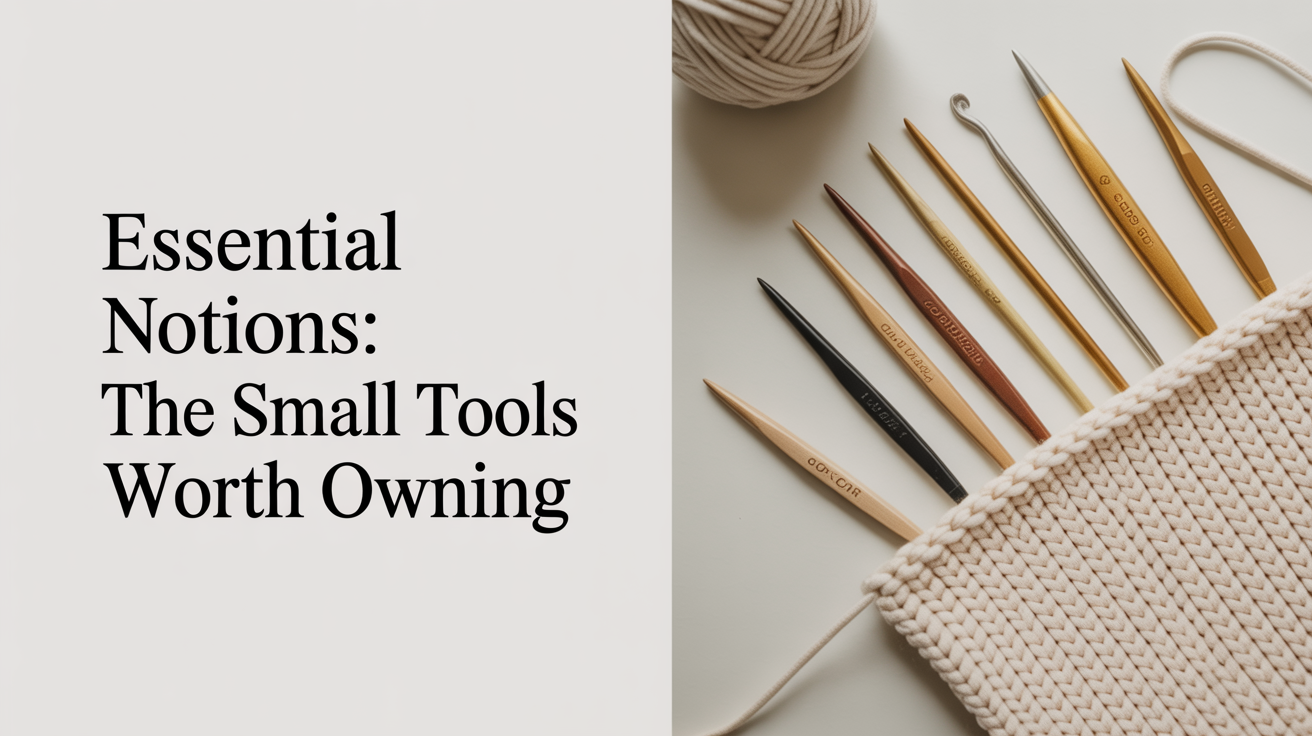
Needles and hooks get most of the attention when you first start knitting or crocheting, but the small accessories that come alongside them, collectively called notions, end up being just as useful. They cost very little, take up almost no space, and fix the kinds of problems that would otherwise have you unraveling half a project.
This guide covers the notions that actually get used rather than gathering dust in a craft drawer. If you are still sorting out which yarn to buy first, the guides on reading a yarn label and understanding yarn weights are good starting points before you stock up on tools.
Stitch Markers
Stitch markers are small rings or clips that you slip onto a needle or hook to mark a specific spot in your work. They do not do anything by themselves; they just hold your place so you do not have to count back from the beginning every time you need to know where a section starts.
For knitters, stitch markers sit between stitches on the needle and slide along as you work. You move them from the left needle to the right needle each time you pass them. A closed ring works here because the marker never needs to come off mid-row unless you want it to.
For crocheters, locking stitch markers (also called split markers or coilless pins) are more useful because crochet stitches do not have a needle running through them. A locking marker clips into a stitch so it stays put even when you set the project down. You can also use a short piece of scrap yarn tied in a loop as a temporary marker.
What to look for: a set that includes a few different sizes or colors. Marking the beginning of a round in one color and a midpoint in another makes counting much easier. Avoid very small markers if you are working with bulky yarn; they can get stuck.
Keep a handful on hand at all times. You will use them far more than you expect.
Tapestry Needles
A tapestry needle (sometimes called a yarn needle or darning needle) has a blunt tip and a large eye wide enough to thread yarn through. You need one to weave in the yarn ends that are left over after casting on, binding off, or changing colors. Those loose tails will unravel if you just trim them short, so weaving them in is a finishing step that happens with every project, no exceptions.
Tapestry needles come in metal and plastic. Metal ones are more durable and slip through stitches more easily; plastic ones are softer on delicate yarn and less risky around children. Get a couple of each if you can, or at least two of the same type, because they disappear easily.
Size matters a little. A needle that is too small will not accommodate thick yarn; one that is too large will split fine yarn or leave visible holes. Most beginner projects use medium-weight yarn, and a mid-size tapestry needle handles that well. If you are working with something very thick or very thin, check the package for yarn weight guidance.
Tapestry needles are also used for seaming pieces together, for example joining the two sides of a knit scarf or sewing the pieces of an amigurumi figure. Learning to use one well is a skill that pays off across every project you make.
Row Counters
A row counter is any tool that helps you track how many rows or rounds you have completed. This sounds trivial until you lose count halfway through a 40-row section and have no idea whether you are on row 22 or row 28.
The most basic version is a small barrel counter that clicks to the next number each time you complete a row. You keep it on your needle or on a cord around your wrist and click it after each row. Simple and reliable.
The other option is a paper tally or a notes app on your phone. Some people prefer writing it down because they can add notes alongside the count, for instance marking which row they changed colors or where a tricky repeat starts. Do whatever you will actually remember to update consistently.
Patterns often ask you to repeat a set of rows a specific number of times before moving on. Without a counter, it is easy to do one repeat too many or one too few, and on a garment that can change the finished length noticeably. On smaller projects like dishcloths or scarves, you might get away without one. On anything longer or more structured, a counter is worth having.
Measuring Tape and a Ruler
A flexible tape measure is essential for checking gauge (how many stitches and rows fit in a 10 cm or 4 inch square) and for measuring your finished project against the pattern's target dimensions. A rigid ruler also helps when you need a firm edge to count stitches precisely across a gauge swatch.
Gauge matters most for anything that needs to fit a body: hats, sweaters, socks, gloves. If you are making a blanket or a bag where exact fit is flexible, you can be more relaxed about it. But if you invest time in a hat pattern only to find it fits a grapefruit rather than a human head, that is usually a gauge problem that a tape measure could have caught early. The guide on choosing the right yarn for beginners covers how yarn choice affects gauge and tension.
Keep a tape measure in your project bag. They roll up small enough that there is no reason not to.
Scissors and Point Protectors
Scissors: You need a pair dedicated to yarn. Small embroidery scissors or craft scissors work well because they are easy to keep in a project bag. Yarn does dull blades over time, so using your fabric scissors for yarn and then paper later will shorten the life of the scissors. A pair that stays with your knitting or crochet supplies and nothing else will last longer.
Point protectors: These are small rubber or silicone caps that slip over the tips of knitting needles when you set down an in-progress project. Without them, stitches can slide off the ends, especially if you are using slippery needles with a smooth yarn. They also protect the needle tips from getting bent or chipped in a bag. You can use a small eraser or a piece of cork in a pinch, but actual point protectors are cheap enough to be worth getting.
Locking clips or binder clips: Helpful for holding your place in a printed pattern, or for temporarily securing the working yarn when you need to set down a crochet project without the hook.
Frequently Asked Questions
Do I need to buy notions right away, or can I wait?
You can start with just needles or a hook and yarn. But stitch markers and a tapestry needle are worth adding early. You will need the tapestry needle as soon as you finish your first project, and stitch markers help even on straightforward beginner work. The others can wait until a pattern calls for them.
Can I substitute household items for notions?
Yes, for most of them. A piece of scrap yarn works as a stitch marker. A large safety pin works as a locking marker. A pencil and paper tracks rows just as well as a barrel counter. You do not need to buy specialized tools before you know whether you enjoy the craft. That said, dedicated tools are more convenient, and they are inexpensive enough that a small set does not feel like a big commitment once you know you want to keep going.
How do I know what size tapestry needle to use?
The needle should thread easily with your yarn without stretching the eye, and the tip should pass through your stitches without splitting them or leaving a visible gap. If you are working with worsted-weight yarn, a standard medium tapestry needle fits. If your yarn is very thick (chunky or bulky), look for a needle labeled for heavy-weight yarn. If it is very thin (fingering or lace weight), a smaller, finer needle will be easier to work with.
Are metal stitch markers better than plastic ones?
Metal markers tend to slide more smoothly on metal needles, but they can snag on some yarn fibers. Plastic locking markers are lighter and less likely to scratch needles with coatings. For most beginners using worsted-weight yarn, either works fine. If you are using a yarn with a halo or loose texture (like mohair), opt for smoother metal rings over plastic clips, which can catch on the fibers.
Where should I store my notions?
A small zip pouch or pencil case works well. Keep it in your project bag so everything travels together. Loose markers and needles have a way of vanishing into bag linings, so anything with a closure is better than an open container.