Yarn & Tools
Yarn Weights Explained: From Lace to Bulky
A plain-English guide to yarn weights for beginners: what the numbers mean, which needle or hook to use, and why worsted is the perfect place to start.
Yarn labels can look like a secret code the first time you pick up a skein. Numbers, symbols, needle ranges, ply counts, it's a lot. But the weight system follows a simple logic: the higher the number, the thicker the yarn, the bigger the needles or hook, and the faster the fabric grows. Once that clicks, everything else falls into place.
At a Glance
- Yarn weight runs on a 0 to 7 scale, lace (0) to jumbo (7), set by the Craft Yarn Council.
- Worsted (weight 4) is the beginner default: thick enough to see stitches clearly, with the largest library of beginner patterns.
- Country matters. US "worsted" is UK/AU "aran." Match by needle or hook mm size, not the name, when working a pattern from another country.
- Needle and hook sizes on the label are ranges, not fixed numbers. Your personal tension decides where in that range you land.
- No label at all? A wraps-per-inch count against a ruler can identify the weight category well enough to pick a starting needle or hook.
- Going up a weight makes a project denser and warmer; going down makes it lighter and drapier, both change the finished size even at the same stitch count.
The Standard Yarn Weight System
The Craft Yarn Council assigns each yarn a number from 0 to 7. You'll often see a small skein icon with a number printed on the label, that's the weight category. Here's what each one covers:
0, Lace. The finest thread, used for delicate shawls and doilies. Very slow to work up and unforgiving of mistakes.
1, Super Fine (also called Fingering or Sock yarn). Still thin, but more approachable. Great for socks, lightweight scarves, and baby garments.
2, Fine (Sport weight). A step up in thickness. Nice for lightweight sweaters and baby items.
3, Light (DK weight). DK stands for "double knit," a British term. It's lighter than worsted but works up faster than sport. Popular for children's garments and lightweight accessories.
4, Medium (Worsted weight). The most common yarn you'll find on store shelves. Smooth, easy to see, and forgiving. This is where beginners belong.
5, Bulky (Chunky weight). Thick yarn that knits or crochets up quickly. Great for scarves, cowls, and simple hats.
6, Super Bulky. Even chunkier. Blankets in a weekend, hats in an hour.
7, Jumbo. The thickest category. Often worked with very large needles or hooks, sometimes even your arms.
Each category also has a typical gauge range attached to it. Worsted, for example, generally knits at around 16 to 20 stitches per 4 inches in stockinette, while bulky drops to around 12 to 15 stitches over the same 4 inches. That gauge range, not just the needle size, is what the Craft Yarn Council's standard system uses to define each weight category, since two yarns can call for the same needle but still produce noticeably different fabric density.
Yarn Weight Chart
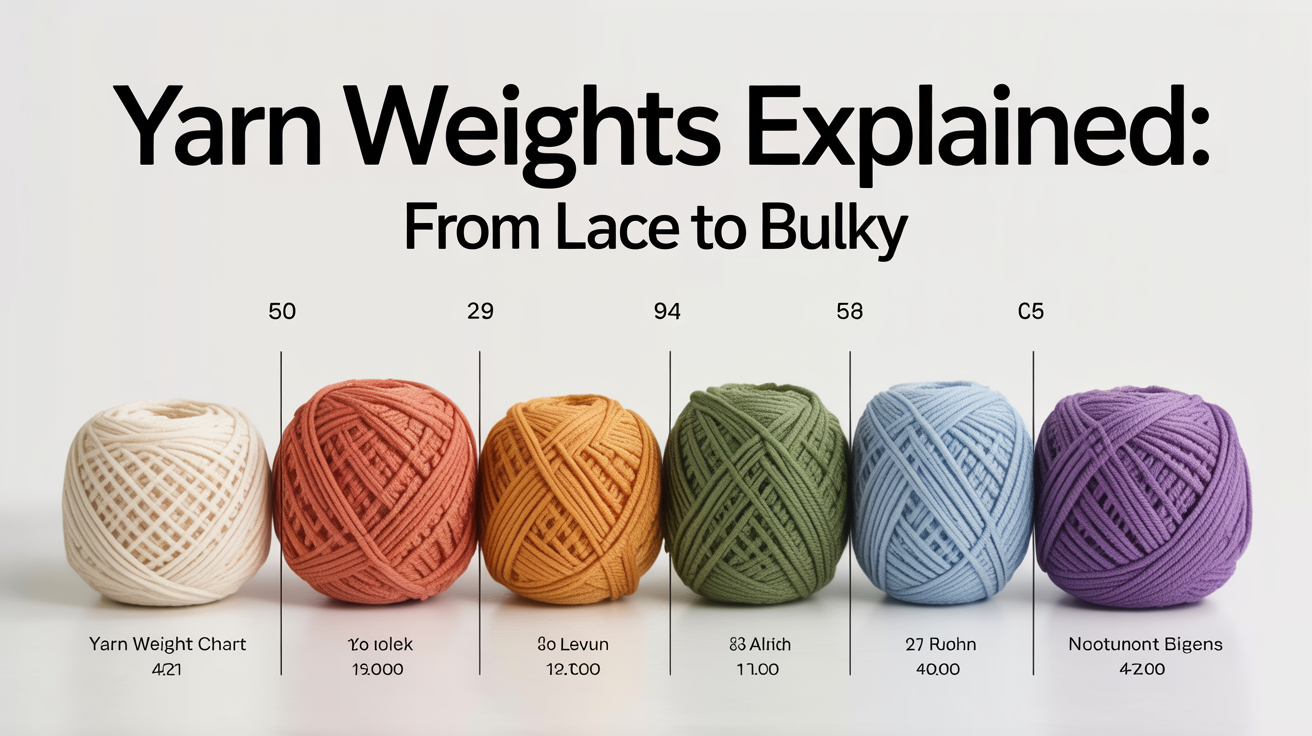
This table covers the key details for each category at a glance.
| # | Name | Example Yarns | Knitting Needle | Crochet Hook |
|---|---|---|---|---|
| 0 | Lace | Rowan Fine Lace, Madelinetosh Lace | 1.5–2.25 mm | Steel 6–8 (1.6–1.4 mm) |
| 1 | Super Fine (Fingering/Sock) | Drops Fabel, Regia 4-ply | 2.25–3.25 mm | B-1 to E-4 (2.25–3.5 mm) |
| 2 | Fine (Sport) | Cascade 220 Sport, Paintbox DK Sport | 3.25–3.75 mm | E-4 to 7 (3.5–4.5 mm) |
| 3 | Light (DK) | Lion Brand 24/7 Cotton DK, Paintbox Simply DK | 3.75–4.5 mm | F-5 to 7 (3.75–4.5 mm) |
| 4 | Medium (Worsted) | Lion Brand Wool-Ease, Caron Simply Soft | 4.5–5.5 mm | G-6 to I-9 (4–5.5 mm) |
| 5 | Bulky (Chunky) | Lion Brand Thick & Quick, Bernat Blanket | 5.5–8 mm | I-9 to K-10.5 (5.5–6.5 mm) |
| 6 | Super Bulky | Loops & Threads Charisma Xl, Big Twist Super Bulky | 8–12.75 mm | M-13 to Q (9–15 mm) |
| 7 | Jumbo | Lion Brand Wool-Ease Thick & Quick Jumbo | 12.75 mm and up | Q and larger (15 mm+) |
Needle and hook sizes here are typical ranges. Always check the gauge swatch, your tension may need a size up or down. The full mm-to-US conversion for every needle and hook in these ranges is laid out in the Craft Yarn Council's hook and needle size chart, which is worth bookmarking alongside this table.
Identifying Yarn Weight Without a Label
Inherited a stash with no ball bands, or found a mystery skein at a thrift store? You can still narrow down the weight category. Wrap the yarn around a pencil for a measured inch, snug and side by side with no overlap, and count the wraps. According to the Craft Yarn Council's wraps-per-inch (WPI) method, roughly 7 to 8 wraps per inch is worsted (weight 4), 11 to 13 wraps per inch is DK (weight 3), and 14 or more wraps per inch puts you in fingering or lace territory (weight 1 or 0). It's an estimate rather than a substitute for a real gauge swatch, since wrapping tension varies from person to person, but it's enough to pick a sensible starting needle or hook instead of guessing blind.
Country Name Differences (US vs UK vs AU)
This trips up a lot of beginners, especially if you're following a pattern from another country. The same physical thickness gets different names depending on where the pattern was written.
Worsted (US) = Aran (UK/AU). In the UK, "worsted" refers to a spinning technique, not a weight. What Americans call worsted, British and Australian knitters call aran. Both are weight 4.
DK (UK) = Light Worsted (US). DK yarn is thinner than worsted. American patterns sometimes label it "light worsted" or just skip a dedicated name for it.
Sport (US) = 5-ply (AU) or 4-ply Sport (UK). Confusingly, UK "4-ply" is close to US fingering/super fine, not US 4-ply constructions. The ply system (2-ply, 4-ply, 8-ply) used in the UK and Australia refers roughly to thickness, not literally the number of plied strands.
8-ply (AU) = DK (UK) = Light Worsted (US). Eight-ply is a common Australian term roughly equivalent to DK.
10-ply (AU) = Aran/Worsted. Twelve-ply is chunky/bulky territory.
When you use a pattern from another country, match by the suggested needle or hook size rather than the name. A UK pattern calling for "aran" yarn and 5 mm needles is asking for what an American would call worsted.
For more on reading a label's full information, this guide to yarn labels covers everything from fiber content to dye lots.
Which Weight Should Beginners Start With?
Start with worsted (weight 4). Full stop.
Here's why it works so well:
You can see every stitch. Lace and fingering yarn are so thin that mistakes hide until you've knitted ten more rows past them. Worsted is thick enough to see each stitch loop clearly, which makes it much easier to spot errors early.
It works up at a satisfying pace. Thin yarn takes forever; jumbo yarn can feel like wrestling a rope. Worsted hits the sweet spot, you'll finish a scarf in a weekend and a hat in an evening.
Almost every beginner pattern is written for it. The pattern library for worsted is enormous. You won't struggle to find projects.
Standard 4.5–5.5 mm needles or a G/H/I hook are easy to hold. They're not so small they strain your hands, and not so large they feel awkward.
If you want something to hold in your hand right now before deciding, this beginner yarn guide walks through specific brands and what to avoid.
A Note on Bulky for Absolute Beginners
Some teachers recommend bulky (weight 5 or 6) because it goes fast and gives quick results, a morale boost when you're learning. That's valid. But the fabric is harder to unravel and re-knit when you make a mistake, and the large stitches can look a little loose until you build consistent tension. Worsted is still the safer first choice.
When to Move to Thinner Yarns
Once you can cast on, complete a project, and bind off without losing stitches, try DK. It opens up lighter garments and baby items. Fingering and lace yarn are best left until you're comfortable reading your knitting, they demand more attention to tension and stitch count.
Hook Sizes for Crochet Beginners
If you're crocheting rather than knitting, the principle is the same: worsted yarn with a 5–5.5 mm hook (US H/8 or I/9) is the friendliest starting combination. The stitches are tall enough to see, and the hook fits naturally in your hand.
Crochet hooks are sized differently in the US and UK, a US I/9 hook is 5.5 mm, while UK sizes run in reverse numerical order. Stick to millimeter measurements to avoid confusion. This hook size guide for beginners explains the full US/UK comparison.
Frequently Asked Questions
What does "ply" mean on a yarn label?
Ply originally referred to the number of single strands twisted together to form the yarn. A 4-ply yarn technically has four strands. In practice, the number of plies doesn't reliably predict weight anymore, manufacturers adjust the thickness of each strand. UK and Australian patterns still use ply numbers as shorthand for weight (4-ply ≈ fingering, 8-ply ≈ DK, 10-ply ≈ worsted), but American labels have mostly moved to the 0–7 number system. When in doubt, match by needle size.
Can I substitute a different yarn weight than the pattern calls for?
You can, but it changes the finished size and drape of the piece. Going one weight heavier makes a larger, denser fabric; going lighter makes it smaller and airier. For accessories like scarves, this is often fine. For fitted garments, stick to the specified weight and always swatch first.
Why does the label show a needle range instead of one size?
Because tension varies between knitters. A "tight" knitter pulls stitches snug and may need a larger needle to hit gauge; a loose knitter does the opposite. The range on the label covers most knitters. The gauge swatch tells you which end of that range (or outside it entirely) works for your hands.
What is "gauge" and does it matter for beginners?
Gauge is the number of stitches and rows per 10 cm (or 4 inches) of knitted or crocheted fabric. For simple projects, dishcloths, scarves, basic hats, gauge matters less. For garments or fitted items, it matters a lot. A small difference in gauge multiplied across hundreds of stitches can make a sweater fit a child instead of an adult.
Is there a weight that works for both knitting and crochet?
All yarn weights work for both crafts. The needle and hook sizes differ for the same yarn: a worsted yarn that knits on 4.5–5.5 mm needles will typically crochet with a 5–6 mm hook. The label usually lists recommendations for both, or you can find the standard ranges in the chart above.
How much yarn do I need if I substitute a heavier or lighter weight?
Yardage, not weight in grams, is what to track. Moving one category heavier (say DK to worsted) at the same finished size typically uses 15 to 25 percent less yardage, since each stitch covers more ground. Moving one category lighter uses roughly that much more. If a pattern calls for 800 yards of worsted and you're substituting DK, plan on closer to 950 to 1,000 yards, and always buy an extra skein when substituting since dye lots and exact yardage-per-skein vary by brand.