Yarn & Tools
What Is Gauge and Why Does It Matter?
Learn what gauge means in knitting and crochet, how to make and measure a gauge swatch, and how to adjust needle or hook size when your numbers are off.
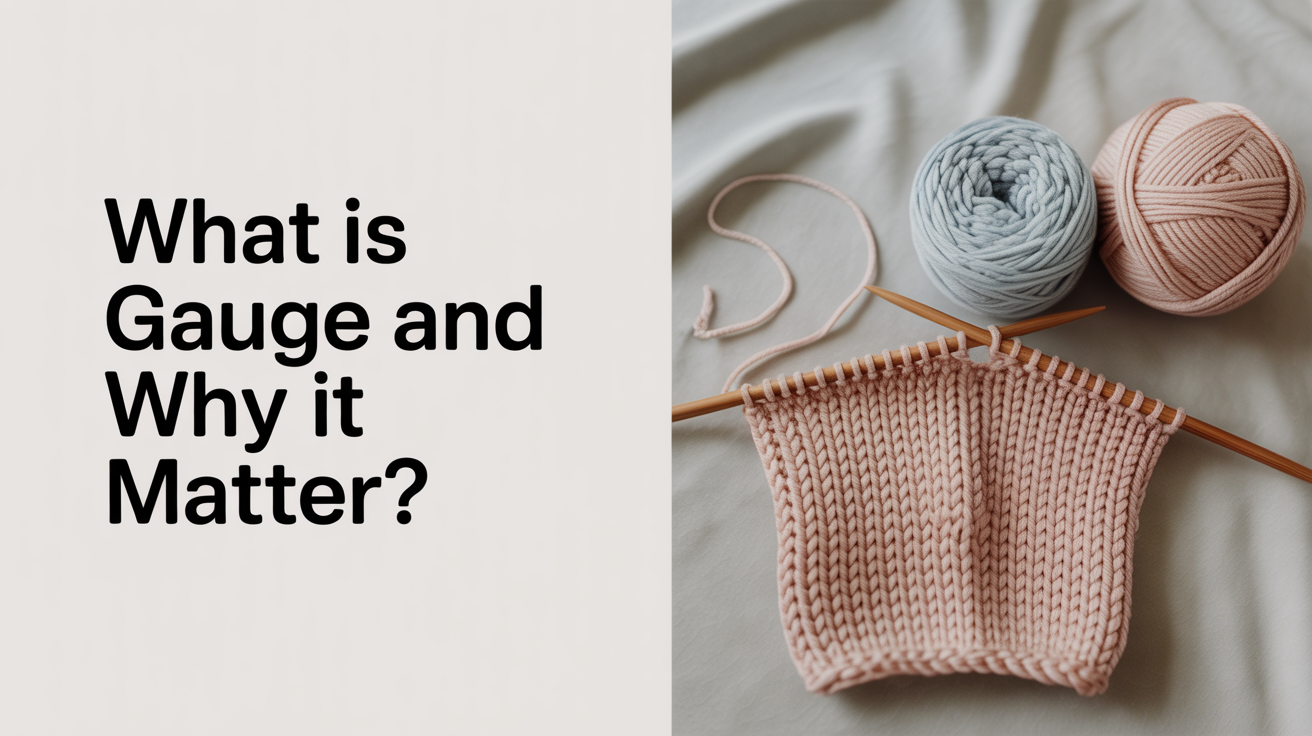
You pick up a pattern, cast on the right number of stitches, and finish what looks like a perfectly good hat. Then you try it on and it fits a grapefruit. Gauge is almost always the culprit when a finished project comes out the wrong size, and it is the one step beginners most often skip.
Gauge tells you how many stitches and rows fit into a given area when YOU work with a specific yarn and needle or hook size. It is not a fixed property of the yarn or the tool. It is personal. Two people using the same materials can produce swatches that measure completely differently because everyone holds yarn and moves their hands in their own way. That is why checking gauge before you start a fitted project is not optional extra credit. It is how you get something that actually fits.
What Gauge Means and How Patterns State It
Every knitting or crochet pattern that involves sizing includes a gauge note. It looks something like this: 20 stitches and 28 rows = 4 inches (10 cm) in stockinette stitch on US 7 (4.5 mm) needles.
That statement contains three pieces of information: the stitch count across, the row count down, and the stitch pattern used for measuring. The standard measuring area is a 4-inch (10 cm) square because it gives a reliable average. Measuring a single inch and multiplying can magnify small counting errors.
Stitch gauge (how many stitches fit across) controls the width of your project. Row gauge (how many rows fit top to bottom) controls the length. Width is usually more critical for things like sweaters and hats, but row gauge matters for garments worked from the top down or for sleeve and armhole shaping.
For crochet gauge, the same principle applies. A crochet gauge note might read: 14 double crochets (dc) and 8 rows = 4 inches in dc on a 5.0 mm hook. Crochet stitches tend to be taller relative to their width, so row gauge often matters more in crochet than in knitting.
How to Make a Gauge Swatch
A gauge swatch (sometimes called a tension square) is a small sample you work before starting your actual project. Here is how to make one that gives you accurate information.
Step 1: Gather Your Materials
Use the same yarn and the same needle or hook size the pattern calls for. If you substitute a different yarn, the yarn weight has to match the one specified. A bulky yarn on a fine needle will never hit sport-weight gauge no matter how tightly you knit.
Step 2: Cast On or Chain More Than You Need
Cast on at least 6 to 8 more stitches than the gauge calls for across 4 inches. The edges of any swatch curl or compress, so you need enough fabric in the center to get a clean reading. If the pattern gauge is 20 stitches over 4 inches, cast on 28 to 30 stitches.
Step 3: Work the Right Stitch Pattern
Work in whatever stitch the pattern specifies for the gauge note. Most often this is stockinette stitch in knitting (knit on the right side, purl on the wrong side) or single crochet (sc) or double crochet (dc) in crochet. Work until your swatch is at least 5 to 6 inches tall so you have enough rows to measure accurately in the center.
Step 4: Bind Off or Fasten Off, Then Block
Bind off (knit) or fasten off (crochet) loosely. Many fibers, especially wool and other natural materials, change size after washing and drying. If your pattern will be washed, block your swatch the same way you plan to block your finished project before you measure it. Pin it flat to a mat or towel, let it dry completely, then measure.
Step 5: Measure in the Center
Lay the swatch on a flat surface without stretching it. Place a ruler or measuring tape horizontally across the center, avoiding the first and last inch on each side. Count how many stitches fit in exactly 4 inches (10 cm). Then place the ruler vertically and count how many rows fit in 4 inches. Write both numbers down.
How to Read Your Numbers and What to Do When They Are Off
Compare your stitch and row counts to the pattern's gauge.
If you have too many stitches in 4 inches: Your stitches are smaller than the pattern expects. Try going up one needle or hook size and swatch again.
If you have too few stitches in 4 inches: Your stitches are larger. Try going down one needle or hook size.
A worked example: say the pattern calls for 20 stitches over 4 inches but your swatch gives you 22 stitches over 4 inches. That means each of your stitches is slightly narrower than the designer's. Across 100 stitches, you would end up with a piece that is about 18 inches wide instead of 20. On a sweater that difference shows up immediately. Switching to a needle one size larger loosens your tension and should bring your count down toward 20.
Always re-swatch after changing needle or hook size. It takes time up front, but it is far less frustrating than ripping out a nearly finished sweater.
Gauge for Projects That Do Not Need to Fit
Not every project requires obsessive gauge checking. A blanket or a dishcloth does not have to measure to the millimeter. Gauge still affects how much yarn you use and the drape and density of the fabric, but being slightly off will not ruin anything.
Fitted items are a different story: hats, mittens, socks, and garments all need to match gauge closely. The yarn label often includes a recommended gauge for that specific yarn, which is a useful starting point before you even look at a pattern.
If you are new to all of this and still working out what yarn to buy, the guide on the best yarn for beginners covers which fiber types are forgiving to work with and which to hold off on until you have more practice.
Frequently Asked Questions
Do I really need to make a gauge swatch every time?
For scarves, dishcloths, and decorative items where exact dimensions do not matter, you can often skip it. For anything fitted, including hats, mittens, and all garments, swatching before you start saves you from ripping out hours of work. It is worth the 20 to 30 minutes.
My gauge matches the stitch count but not the row count. What do I do?
Stitch gauge controls width, and row gauge controls length. Many knitting patterns give instructions by length in inches rather than by row count, so a slight difference in row gauge is often manageable. You just work until the piece measures the right length rather than stopping at a specific row. If the pattern does give critical shaping instructions by row number, you may need to adjust or recalculate. Crochet patterns tend to use row counts more frequently, so row gauge matters more there.
Can I skip blocking my swatch?
You can, but your measurement may not match what the finished item will look like after washing. Wool in particular can shift quite a bit when wet. If you know you will never wash the finished project, skip it. Otherwise, take the extra step.
Why does my gauge change when I knit in the round versus flat?
Many knitters purl more loosely than they knit, so working flat (alternating knit and purl rows) can produce different results than working every row as a knit stitch in the round. If your pattern is worked in the round, try swatching in the round, either on circular needles or by working back and forth and cutting the yarn at the end of each right-side row to simulate the same motion.
What if I cannot get my gauge to match no matter what needle size I try?
Sometimes the yarn itself is the issue. A yarn that is slightly thinner or thicker than the weight the pattern calls for will not hit gauge with any hook or needle. Check the yarn weight guide to make sure your yarn is actually the right weight category for your pattern. If it is not, the pattern was written for a different yarn and the gauge problem is structural, not a tension issue you can fix by switching needle size.