Getting Started
10 Beginner Knitting and Crochet Mistakes (and How to Fix Them)
Made a mistake in your knitting or crochet? Good news: most beginner slip-ups are easy to fix. Here are 10 common ones and exactly what to do.
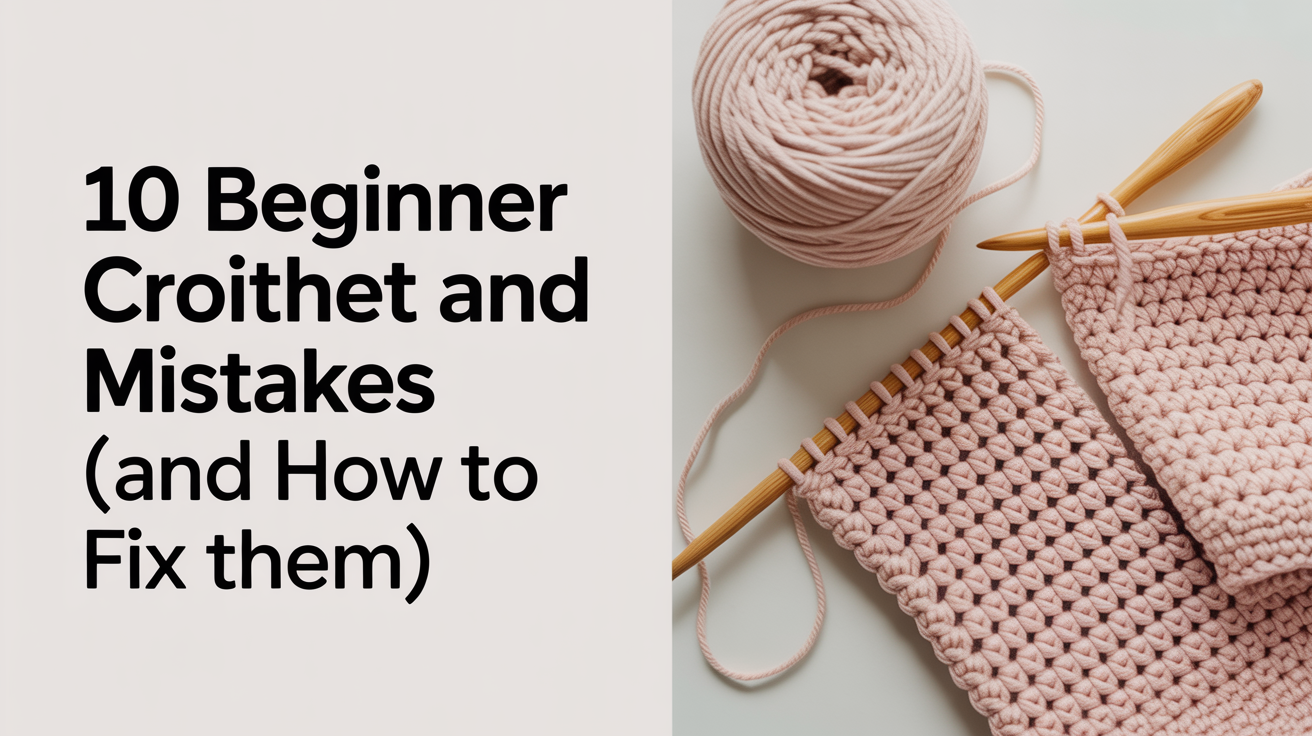
Every beginner makes mistakes. The yarn tangles, the stitch count drifts, the edges go wavy. None of that means you're bad at this, it means you're learning. Most of these problems have straightforward fixes, and catching them early makes the whole process a lot more enjoyable.
Here are ten mistakes that trip up almost every new knitter and crocheter, plus what to do when they happen to you.
Quick-Reference Table
| Mistake | Common Cause | Fix |
|---|---|---|
| Stitches too tight to work | Gripping yarn/hook too hard | Loosen your hold; practice on bigger needles |
| Stitch count creeping up | Accidental yarn-overs or split stitches | Count after every row |
| Dropped stitches | Needles slipping out | Use needle caps; rescue with a crochet hook |
| Crochet edges widening | Extra stitches at row ends | Chain correctly before turning; count edge stitches |
| Losing count mid-project | No markers or breaks | Place a stitch marker every 10–20 stitches |
| Splitting the yarn | Hook/needle going between plies | Aim for the center of each stitch |
| Wrong-side confusion | No markers for RS/WS | Attach a safety pin to the right side at cast-on |
| Skipping gauge swatch | Seems unnecessary | Always swatch; adjust hook/needle size to match |
| Dark or fuzzy yarn | Looks stylish, hard to see stitches | Start with smooth, light-colored yarn instead |
| Giving up after one mistake | Perfectionism | Frog it, restart the row, keep going |
The 10 Mistakes (and Their Fixes)
1. Tension So Tight You Can Barely Move the Stitches
This is the most common beginner mistake. New crafters grip the yarn and hook (or needles) as if they're afraid something will escape. The stitches end up packed so tightly that sliding them along the needle feels like a workout.
Why it happens: Anxiety. You're concentrating so hard that your whole body tenses up, including your hands.
The fix: Go up one needle or hook size temporarily and practice just moving stitches around without knitting them. Notice how little grip you actually need. A loose hold produces better fabric and hurts less after an hour of crafting. If you're knitting, try how to hold knitting needles and a crochet hook for a refresher on hand position.
2. Accidentally Adding Extra Stitches
You cast on 20 stitches, knit a few rows, and suddenly you have 23. Nobody added them, they appeared somehow.
Why it happens: In knitting, the yarn accidentally loops over the needle between stitches, creating an extra. In crochet, it's easy to work into the turning chain by mistake and treat it as a real stitch.
The fix: Count your stitches at the end of every row for your first several projects. It takes ten seconds and saves you from ripping out three inches of work later. Stitch markers help too, place one every ten stitches so if the count is off, you know exactly which section to look at.
3. Dropped Stitches in Knitting
A stitch slides off the needle and starts unraveling down the fabric like a run in a stocking. Panic is understandable, but this is genuinely fixable.
The fix: Stop. Don't keep knitting. A small crochet hook (similar size to your knitting needle) can catch the dropped stitch and pull the horizontal bars back through it one at a time, all the way up to the needle. Look up "how to fix a dropped knit stitch" and you'll find this technique demonstrated in under two minutes. To prevent it, use rubber needle caps on the ends when you put your work down.
4. Crochet Edges That Creep Wider
Your crochet rectangle starts out straight, but by row ten it's a trapezoid. The edges are wider than the middle.
Why it happens: You're accidentally adding stitches at the beginning or end of each row. In single crochet, the turning chain (ch 1) does NOT count as a stitch, beginners often work into it anyway, adding one stitch per row.
The fix: After you chain and turn, skip that chain and work your first stitch into the actual first stitch of the previous row. Count your stitches at the end of the row before moving on. If you have more than you started with, you'll see exactly where the extra came from.
5. Losing Count in the Middle of a Row
You were at stitch 14, someone said your name, and now you have no idea where you are.
The fix: Stitch markers are your best friend. Place one every 10 or 20 stitches so you only ever need to count a short run. In a pinch, a loop of scrap yarn works perfectly as a marker. Some people also keep a simple tally on a notepad next to them, marking off each repeat as they go.
6. Splitting the Yarn
Your needle or hook goes between the plies of the yarn instead of through the center of the stitch. The resulting stitch looks messy and is hard to work later.
Why it happens: The angle of your hook or needle is off, or the yarn has a very loose twist that makes it easy to pierce.
The fix: Aim directly for the center of each stitch and watch the hook or needle tip as it goes in. Tightly twisted, smooth yarn (like cotton or a basic acrylic) is much harder to split than loosely spun yarn. If you're splitting constantly, the yarn might just not be beginner-friendly, swap it out.
7. Losing Track of Which Side Is the Right Side
Both sides of your work look similar and you've lost track of which is the front. This matters once you start reading patterns that say "with RS facing."
The fix: Attach a safety pin or a piece of contrast yarn to the right side of your work at the very beginning and leave it there until you're done. You never have to wonder again. As a bonus, in knitting this also tells you which row is which, if the safety pin is facing you, you're working a right-side row.
8. Skipping the Gauge Swatch
A pattern says "14 stitches = 4 inches" and you think, "I'll just start." Three inches in, you realize your tension is wildly different and the finished item will be the wrong size.
The fix: Knit or crochet a small swatch, usually about 6 inches square, with the yarn and needle/hook the pattern calls for, then measure it. If you have more stitches per inch than the pattern, go up a needle/hook size. Fewer stitches? Go down. For a scarf or a dishcloth, gauge barely matters. For a sweater, it's everything. Getting into the habit early saves a lot of heartbreak later.
9. Starting with Dark or Fuzzy Yarn
That deep charcoal merino looked gorgeous in the store. On the needles, you can't see individual stitches at all, which means you can't count them, find your place, or spot mistakes.
The fix: Your first two or three projects should use smooth, light-colored yarn, cream, pale yellow, light gray. You need to be able to see exactly what your hands are doing. If you already bought dark yarn, set it aside for a future project and pick up something light first. Check knitting and crochet supplies every beginner needs for guidance on choosing beginner-friendly materials.
10. Giving Up After One Mistake
You drop a stitch, or realize you've been doing a stitch wrong for five rows, and the temptation to stuff everything in a drawer is real.
The fix: Frog it. "Frogging" means ripping back your work (the name comes from "rip it, rip it", like a frog). Pull the needle or hook out and gently tug the yarn to unravel back to a good point. It feels dramatic the first time. By the fifth time, it's just a normal part of the process, even experienced crafters do it constantly. Starting over on a small section is not failure. It's how the work gets better.
A Note on Frogging
New crafters sometimes worry that frogging will damage the yarn. It won't. Yarn is resilient. After you rip back, give the yarn a gentle tug to even out the kinks, reinsert your needle or hook, and keep going. Some people frog and restart the same small square four or five times while they're learning a new technique, that's a perfectly reasonable use of an evening.
If you're unsure whether knitting or crochet is the right fit for your learning style, knitting vs. crochet, which should a beginner learn first walks through the differences in a practical way.
Frequently Asked Questions
How do I know if my tension is too tight or too loose?
Try sliding your stitches along the needle or hook. They should move with light pressure, not fall off on their own, but not require force either. If you have to yank them along, your tension is too tight. If they slide freely and the fabric looks airy and open when it shouldn't, it's too loose. The gauge swatch is the most reliable test: compare your stitch count per inch against the pattern's target.
Is it normal to have to rip back and restart?
Very normal. Experienced knitters and crocheters frog sections of work all the time. The goal isn't a mistake-free project, it's a finished one you're happy with. Ripping back is a skill in itself, and getting comfortable with it removes a lot of the anxiety around making errors.
What's the easiest fix for a stitch I made wrong several rows ago?
It depends on how severe the mistake is. For a twisted stitch or a minor irregularity, many knitters just leave it, it often disappears into the fabric. For a dropped stitch or a structural error (like an extra stitch that's throwing off your count), it's almost always worth ripping back to that row and fixing it. A mistake left in place tends to compound over the next several rows.
Why does my crochet look different from the photos in the pattern?
A few things could be at play: your tension, your hook size, the yarn fiber and weight, or the fact that professional pattern photos are often taken in ideal lighting with perfectly blocked finished objects. Small differences in how your work looks are normal. If the stitch structure is correct and your count is right, you're probably doing just fine.
Can I fix a mistake without ripping back all my work?
Sometimes. Dropped stitches in knitting can be picked back up stitch by stitch with a crochet hook. Twisted stitches can sometimes be corrected on the next row. Minor tension issues often even out over time or after blocking. But for anything that affects the stitch count, extra or missing stitches, the most reliable fix is to rip back to where the problem started. It's frustrating, but it's faster than trying to compensate for a structural error over the next twenty rows.