Getting Started
How to Choose Your First Knitting or Crochet Project
Learn how to pick a beginner-friendly first crochet or knitting project. Includes a checklist, a list of top starter projects, and answers to common questions.
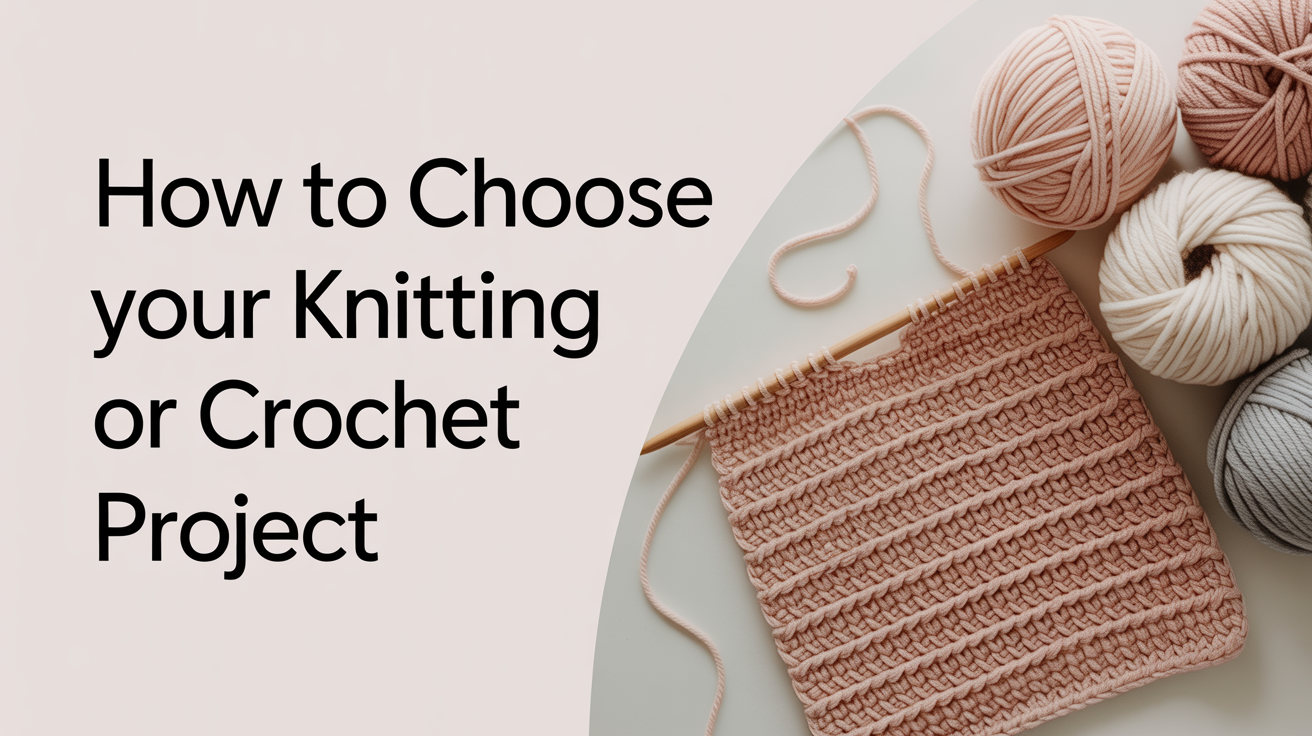
Picking your first knitting or crochet project feels harder than it should be. You browse patterns online, fall in love with a cable-knit sweater or a lacy shawl, and then feel stuck because the instructions look like a foreign language. Here is the good news: the right first project is not the prettiest one in the shop. It is the one that teaches you the core movements without burying you in complexity before you have built up any muscle memory.
Whether you are looking for an easy first project for crochet or deciding what to knit first, the criteria are the same. You want something small enough to finish in a sitting or two, made with a stitch you can actually see, and simple enough that a mistake does not unravel your confidence along with the yarn.
What Makes a Project Beginner-Friendly
Not every "beginner" label on a pattern means the same thing. Some patterns marked easy assume you already know how to read abbreviations, manage multiple yarn colors, or work in the round. Before you commit to a project, run it through this checklist.
Checklist: Is This Project Right for a Beginner?
- Uses only one or two basic stitches (knit and purl for knitting; chain and single crochet for crochet)
- Works flat (back and forth in rows), not in the round, until you feel steady
- Uses medium-weight (worsted or bulky) yarn in a light, solid color so you can see each stitch clearly
- Calls for a needle or hook size in the range of 5 mm to 8 mm -- easier to control than very fine or very large tools
- Has fewer than 30 stitches per row so you can count and recount without losing your place
- Has no shaping (no increases, decreases, or seaming) in the first version, or very minimal shaping
- Can be finished in a few hours or a single weekend at most
- Does not require gauge swatching to "fit" -- scarves, dishcloths, and simple pouches are forgiving of small variations
If a project fails more than two or three of these, set it in your favorites folder and come back to it after a few weeks of practice.
Good First Projects for Knitting and Crochet
Here is a side-by-side look at popular starter projects and what each one actually teaches you.
Knitting Starter Projects
Dishcloth or washcloth. A square or rectangle worked entirely in knit stitches (garter stitch) or alternating knit and purl rows (stockinette). You practice casting on, working rows, and binding off (casting off). The finished object is useful, so it does not feel like homework. Size: roughly 20 to 25 stitches wide.
Simple scarf. Same skills as a dishcloth, stretched out longer. The repetition locks in your tension and teaches you how to hold yarn comfortably over a longer session. Choose a chunky yarn and large needles (8 mm or bigger) if you want to see results fast.
Seed-stitch coaster. You alternate knit and purl stitches within the same row, which teaches you how to move the yarn between the front and back of your work. It is a small, forgiving piece that builds a skill you will use constantly.
Crochet Starter Projects
Dishcloth or granny square. A square dishcloth worked in rows of single crochet (sc) is the most direct first crochet project you can choose. It covers chaining, inserting the hook, pulling through loops, and counting rows. Granny squares add a small step into working in the round, which is a core crochet skill.
Simple headband. A rectangle of single crochet or half-double crochet (hdc) stitched into a loop. It has a clear purpose, fits most heads without precise sizing, and finishes quickly. The join at the end is your first taste of seaming.
Bookmark or plant hanger. Both are narrow, short, and teach you how to chain and work basic stitches without committing to a large project. A macrame-style plant hanger skips most stitchwork but practices tensioning and knotting, which transfers back to yarn crafts.
What NOT to Start With
Amigurumi (crocheted stuffed animals) look simple because of their size, but they require working in a magic ring, invisible decreases, and often changing colors. Sweaters, socks, and fitted garments involve shaping and gauge math. Lace patterns in either craft rely on reading charts and working yarn-overs with precision. Save these for after your first three or four projects.
How to Read a Simple Pattern Before You Start
Patterns use abbreviations that look intimidating the first time. In knitting, "k" means knit and "p" means purl. "CO" is cast on and "BO" or "bind off" is how you finish. In crochet, "ch" is chain, "sc" is single crochet, "hdc" is half-double crochet, and "sl st" is slip stitch. Any pattern written for true beginners will spell these out in a key at the top or link to a stitch glossary.
Before you start, read the entire pattern once without touching your yarn. Mark anything you do not recognize and look it up. Most common stitches have short video tutorials you can find by searching the stitch name. Watching the motion once is worth ten minutes of reading a written description.
Also check the pattern for any materials you do not own. Stitch markers, a yarn needle (also called a tapestry needle), and scissors are the only extras most beginner projects need. If you want a fuller rundown of what to buy, see our guide to knitting and crochet supplies every beginner needs.
Matching the Project to Your Craft
If you have not yet decided whether you are knitting or crocheting, the choice of first project might actually help you decide. Knitting tends to reward patience with repetitive rows and develops a feel for two needles working together. Crochet moves faster for many people, uses a single hook, and some find it easier to correct mistakes because you only have one live stitch on your hook at a time.
Our full breakdown of knitting vs. crochet for beginners covers the differences in more detail. But if you just want to start today, pick whichever craft came with the tools you already have. Both paths lead to the same place.
Once you have your project picked out, spend five minutes before your first row getting comfortable with how you hold your tools. How you grip the needle or hook affects tension and hand fatigue more than almost anything else. Our guide on how to hold knitting needles and a crochet hook walks through a few common positions and helps you find one that does not cramp your hands.
Setting Yourself Up to Actually Finish
The biggest risk with a first project is not choosing something too simple. It is choosing something you lose interest in halfway through. A few things that help:
Keep it short. A project you can finish in two or three sessions is more motivating than one that stretches over weeks. You want to feel that sense of completion before you commit to something bigger.
Use yarn you actually like. Pick a color that makes you happy to look at. You will be staring at it for hours. Avoid novelty yarns with fuzzy, bumpy, or sparkly textures for your first project -- they hide the stitches and make it hard to see what you are doing.
Count out loud. On every row, count your stitches at the end before you turn your work. One dropped stitch in row three can throw off everything that follows. Counting takes ten seconds and saves twenty minutes of unraveling.
Accept that the first few inches will not look perfect. Tension evens out as your hands learn what to do. The stitches on rows three through ten will look noticeably better than rows one and two. Keep going.
Frequently Asked Questions
What is the easiest first crochet project for a complete beginner?
A small dishcloth worked in rows of single crochet (sc) is the most straightforward option. You chain a foundation row of about 20 to 25 stitches, then work single crochet back and forth until you have a square. The whole project uses two skills -- chaining and single crochet -- and finishes in under two hours for most beginners.
What should I knit first as an absolute beginner?
A garter-stitch washcloth or scarf is the standard recommendation. Garter stitch means every row is a knit stitch, so you never need to switch between knit and purl. Cast on 20 to 25 stitches, knit every row until the piece is as long as you want, then bind off. That one project teaches you casting on, knitting, and binding off, which are the three skills every other pattern builds on.
How long should a first project take to finish?
A beginner dishcloth or simple scarf should take two to four hours of total work, spread over one or two sessions. If a project seems like it will take weeks from the start, it is probably not the right first choice. You want to complete something and feel the satisfaction of a finished object before you take on more.
Should I follow a pattern or just practice stitches without one?
Both approaches work. Practicing without a pattern (called swatching) is great for getting comfortable with the basic motion. But following a simple pattern teaches you how to read instructions and count rows, which you will need for every project after this one. Try doing a few rows of free practice first, then switch to a simple pattern once the stitch motion starts to feel automatic.
Can I start with a granny square as my first crochet project?
Yes, with one note: a granny square requires working in the round, using a slip stitch (sl st) to join rounds, and making chains at the corners. It is not as simple as a flat dishcloth, but it is still very achievable for a first project if you find a pattern written for beginners that explains each step. Just watch one video of the magic ring or starting chain before you begin so the round-opening technique makes sense.