Projects & Patterns
How to Knit a Scarf for Beginners
Learn how to knit a scarf from scratch with this step-by-step beginner guide. Garter stitch, worsted yarn, US 8 needles, and tidy edges.
A knitted scarf is the perfect first project. It uses just one stitch (really), has no shaping, and by the time you finish, you'll have something warm and real to show for it. This guide walks you through everything: what to buy, how to cast on, the actual pattern row by row, and how to finish cleanly.
At a Glance
- Get 2 skeins of worsted-weight (category 4) yarn, roughly 400 yards total, and US 8 (5 mm) straight needles.
- The whole pattern is garter stitch: knit every row, no purling, no shaping.
- Cast on 30 stitches for a scarf about 5 inches wide; scale up or down using the chart below.
- Knit until the piece measures 60 inches, then bind off.
- Slip the first stitch of every row purlwise for tidy, chained edges.
- Expect 8 to 15 hours of knitting time spread across one to two weeks of evening sessions.
What You Need
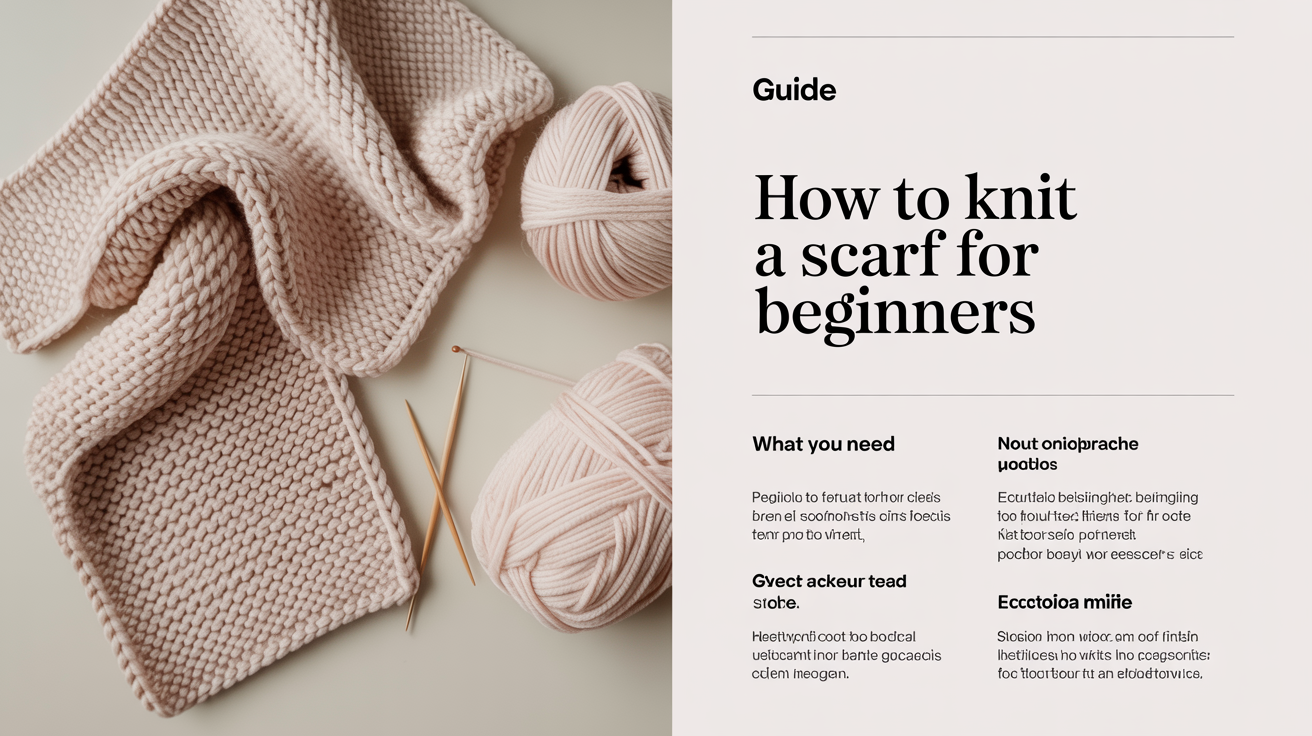
You don't need much. Here's the full list before you head to the store.
Yarn
Get 2 skeins of worsted-weight yarn (look for "worsted" or a number 4 on the label). Worsted is one of the standardized categories in the Craft Yarn Council's Standard Yarn Weight System, which pairs category 4 yarn with a stockinette gauge of 16 to 20 stitches per 4 inches and US 7 to 9 needles, exactly the range this pattern sits in. A smooth yarn in a solid or semi-solid color is the easiest to work with as a beginner, because you can clearly see your stitches. Acrylic yarns are washable, inexpensive, and forgiving. Good beginner options include Lion Brand Pound of Love, Red Heart Soft, or any store-brand worsted.
Two skeins gives you roughly 400 yards total, which is more than enough for a 60-inch scarf with room to spare.
Needles
You need a pair of US 8 (5 mm) straight knitting needles, at least 9 inches long. Bamboo or wood needles grip the yarn slightly, which makes them easier to control than metal when you're just starting out. The length doesn't need to be longer than 9 inches because a 30-stitch scarf is narrow.
Other supplies
- A tapestry needle (also called a yarn needle) to weave in the ends at the finish
- Small scissors
- A measuring tape or ruler
That's it.
Understanding the Garter Stitch
This scarf uses the garter stitch, which means you knit every single row. There's no purling, no pattern to memorize, no switching between different stitches. Knit every row. Done.
The result is a squishy, ridged fabric that looks the same on both sides. It also lies flat naturally, which is exactly what you want in a scarf, unlike stockinette, which curls at the edges without a border.
If you've never held needles before, it's worth reading through how to read a knitting or crochet pattern for beginners first so the terminology here makes sense.
Abbreviations used in this pattern (matching the Craft Yarn Council's standard knitting abbreviations):
- CO = cast on
- k = knit
- BO = bind off
- st(s) = stitch(es)
- rep = repeat
The Beginner Scarf Pattern
Finished dimensions: Approximately 5 inches wide x 60 inches long
Yarn: 2 skeins worsted weight (approx. 400 yards total)
Needles: US 8 (5 mm) straight needles
Gauge: Roughly 18 stitches = 4 inches in garter stitch (gauge matters less for a scarf than for fitted garments, so don't stress about this)
Cast-on width reference
Use this table to size the scarf up or down before you cast on. All figures assume worsted weight yarn on US 8 needles at roughly 18 stitches per 4 inches in garter stitch.
| Cast-on stitches | Finished width | Best for |
|---|---|---|
| 20–24 | About 3.5–4 in | Narrow cowl-style scarf, kids' scarf |
| 30 | About 5 in | Standard adult scarf (this pattern) |
| 36–40 | About 6–7 in | Wider, wrap-style scarf |
| 44–50 | About 7.5–8.5 in | Oversized or blanket scarf |
Step 1: Make a Slip Knot
Make a loop with the yarn, bring the tail end through the loop from underneath, and pull snug around one needle. This is your first stitch. Don't pull it too tight.
Step 2: Cast On 30 Stitches
Use the long-tail cast on or the backward loop cast on (also called the thumb cast on). Either works fine for this project.
Long-tail cast on is worth learning because it creates a stretchy, tidy edge. There are clear video tutorials on YouTube if you search "long-tail cast on beginner."
Cast on until you have 30 stitches total on your needle, including the slip knot. Count them. 30 stitches gives you a scarf about 5 inches wide with US 8 needles and standard worsted yarn.
Step 3: Knit Every Row
This is the whole pattern.
- Hold the needle with the stitches in your left hand and the empty needle in your right.
- Insert the right needle into the first stitch from left to right, going under the left needle.
- Wrap the yarn counterclockwise around the right needle.
- Pull the wrapped yarn back through the stitch.
- Slide the old stitch off the left needle.
- Repeat steps 2 through 5 for every stitch across the row. That's one row.
- Switch needles: the full needle goes to your left hand, the empty one to your right.
- Knit across again.
Keep going until the scarf measures 60 inches from the cast-on edge. Check with a measuring tape laid flat on a table.
At a moderate pace, most beginners knit one to two rows in a few minutes. A 30-stitch row usually takes 3 to 6 minutes once you're past the first few sessions, which puts a 60-inch scarf at roughly 400 to 500 rows total. Expect to spend several sessions on this.
Step 4: Tidy Edge Trick (Optional but Recommended)
To keep your edges looking neat instead of wavy or loopy, slip the first stitch of every row purlwise (insert the right needle from right to left, don't wrap the yarn, just slide the stitch over). This creates a smooth, chained edge down both sides. It's optional, but the result looks noticeably cleaner.
Step 5: Bind Off
When your scarf is 60 inches long (or as long as you want), it's time to bind off.
- Knit the first 2 stitches normally.
- Insert the left needle into the first stitch you knitted (the one furthest from the tip on the right needle).
- Lift it up and over the second stitch and off the needle. One stitch bound off.
- Knit 1 more stitch, then repeat step 2 and 3.
- Continue across the row until 1 stitch remains.
- Cut the yarn, leaving a 6-inch tail. Pull the tail through the last stitch and snug it up.
How Much Yarn Will This Use?
A 30-stitch, 60-inch garter-stitch scarf typically uses 200 to 280 yards of worsted yarn, depending on your tension and exact length. Two 200-yard skeins cover you with extra. If you're using a thicker bulky yarn or going longer than 60 inches, you may need a third skein.
A good habit: weigh the first skein before you start, knit until it runs out, and note how many inches you've done. If a 200-yard, 100-gram skein gets you to 30 inches, you know the second skein will roughly double that to 60 inches, with a small buffer for fringe or a longer wrap.
Fixing Wonky Edges and Common Mistakes
My edges are loopy and uneven
This almost always happens because the first stitch of the row is being knitted loosely. After you turn the work, give a gentle tug on the working yarn (the yarn connected to the skein) before knitting the first stitch. Alternatively, use the slipped-stitch edge trick from Step 4 above.
I have more or fewer stitches than I started with
Count your stitches every 10 rows or so. If you're gaining stitches, you might be accidentally knitting into the yarn between stitches (a "yarn over") or knitting twice into one stitch. If you're losing stitches, a stitch may have dropped off the needle unnoticed and needs to be picked back up before it ladders further down.
For a scarf, a stitch or two off isn't catastrophic. Fix it by carefully picking up a dropped stitch with a crochet hook, or just accept it and move on. A gain or loss of 1 stitch out of 30 changes the finished width by roughly an eighth of an inch, not enough to notice once the scarf is worn. The scarf will still be warm.
My tension feels really tight
Tight tension usually means your stitches are sitting too far back on the needle, or you're gripping the needles too hard. Try to relax your hands. The stitches should slide freely from needle to needle, not need to be pushed. If it helps, go up one needle size (US 9) to open things up.
I have a hole in the fabric
A hole is usually a dropped stitch that ran down a row or two. Use a crochet hook to catch the loose loop and pull it back through the rows above it, one at a time. Search "fix dropped stitch knitting" on YouTube if you want to see the motion.
If you're new to reading patterns and find the abbreviations confusing, how to read a knitting or crochet pattern for beginners breaks down the shorthand in plain language.
Finishing Your Scarf
Weaving In the Ends
You'll have two yarn tails: one at the cast-on edge, one at the bind-off edge. Thread each through the tapestry needle and weave it through the back of the fabric in a zigzag for about 2 inches, then trim the excess. This secures it without a visible knot.
Don't tie a knot; knots can pop through to the front over time. Weaving works better.
Blocking (Optional)
Blocking means wetting the scarf, gently squeezing out the water (don't wring), laying it flat to the right dimensions, and letting it dry. Blocking evens out uneven tension and makes the fabric look more polished. For most acrylic yarns it's optional, but it makes a real difference with wool. Garter stitch is naturally flat, so blocking here is purely cosmetic rather than corrective; it won't fix a real gauge problem the way it can on a curling stockinette piece.
Adding Fringe
Fringe is easier than it looks. Cut lengths of yarn about 14 inches long. Fold one length in half, insert the folded end through a stitch along the cast-on edge with a crochet hook, pull the tails through the loop, and snug them up. Repeat evenly across both short ends, then trim the fringe to a consistent length.
Six to eight fringe groups per end is a nice density. It uses an extra half-skein of yarn at most.
Fringe Alternatives
If fringe isn't your style, two other finishes work well on a garter scarf without adding any new skills:
- Pompoms. A single 3 to 4 inch pompom at each corner, or a small trio spaced along the short ends, gives a playful finish. Wrap yarn 60 to 80 times around a fork or a pompom maker for a dense pompom that size, then trim and tie it to the corner stitch with a short leftover length of yarn.
- A simple twisted cord. Twist two long lengths of yarn together until they kink, then let them fold in half and twist around themselves. Attach one to each short end as a drawstring-style tie instead of fringe. This uses less yarn than fringe and adds no bulk to the scarf's ends.
Either option uses scraps from your existing skeins, so you don't need to buy anything extra.
What to Make Next
Once the scarf is done, you'll have a solid feel for casting on, the knit stitch, and binding off. Those three skills open up a lot. Dishcloths are a classic next step because they're small and let you practice consistent tension. You can also branch into crochet if you're curious. How to crochet a dishcloth is a fast project that teaches you the basics of holding a hook. And if you'd rather stay in scarf territory but try a hook instead of needles, how to crochet a scarf walks through a similarly simple all-beginner pattern.
Frequently Asked Questions
How long does it take to knit a scarf as a beginner?
Expect 8 to 15 hours spread over several sessions, depending on your pace and how often you stop to count stitches or fix mistakes. Most people finish in one to two weeks of casual evening knitting.
What is the best yarn for a beginner knit scarf?
A smooth, medium-weight (worsted or "4") acrylic yarn in a solid color. Smooth yarns let you see your stitches clearly, which makes it much easier to catch mistakes. Avoid novelty yarns (furry, sequined, or highly textured) until you're comfortable with the basics.
How many stitches do I cast on for a scarf?
30 stitches on US 8 needles gives you a scarf about 5 inches wide. For a wider scarf (6 to 7 inches), cast on 36 to 40 stitches. For a narrow cowl-style scarf, try 20 to 24 stitches. See the cast-on width table above, and always knit a few rows and measure before committing to the full length.
Can I knit a scarf without a pattern?
Yes. This scarf is essentially pattern-free: cast on, knit every row, bind off when it's long enough. That's the whole thing. Garter stitch is forgiving, and the only real skill is keeping your stitch count consistent.
Do I need to block a knitted scarf?
Not for most acrylic yarns. If you're using wool or a wool blend, a light wet block will relax the stitches and give the scarf a more even, polished look. Acrylic can be "killed" (permanently relaxed) by steam, so read your yarn label and avoid high heat unless you want a limp, flat result.
What if my scarf comes out a different width than the pattern says?
Your personal tension changes the outcome more than the needle size. If a 30-stitch swatch measures wider or narrower than 5 inches after a few rows, that's your gauge talking, not a mistake. You can adjust by going up or down a needle size, or simply cast on more or fewer stitches using the width table above to hit your target measurement.