Knitting Basics
How to Purl: The Purl Stitch Explained
Learn how to purl stitch step by step. This beginner guide covers technique, common mistakes, and how knit and purl rows combine to make stockinette fabric.
If you've already learned the knit stitch, you're closer to purling than you think. The purl stitch is simply a knit stitch worked from the other direction, same yarn, same needles, same loop logic, just approached from the front instead of the back. Once it clicks, you'll have both foundational stitches under your belt and can start creating real fabric textures.
What Is the Purl Stitch?
A purl stitch is the reverse of a knit stitch. When you knit a row and then flip your work, every stitch on the back looks like a purl. So in a very real sense, you already know what a purl looks like, it's that little horizontal bump you see on the wrong side of a knit fabric.
This relationship matters practically. Knit one row, purl the next, keep repeating, and you get stockinette, the smooth, V-patterned fabric used in most sweaters and basic garments. The knit rows form the smooth "right" side, and the purl rows form the bumpy "wrong" side.
If you haven't practiced the knit stitch yet, start with how to knit the knit stitch for beginners before continuing here. You'll also want to know how to cast on if you're starting from scratch.
Setting Up to Purl
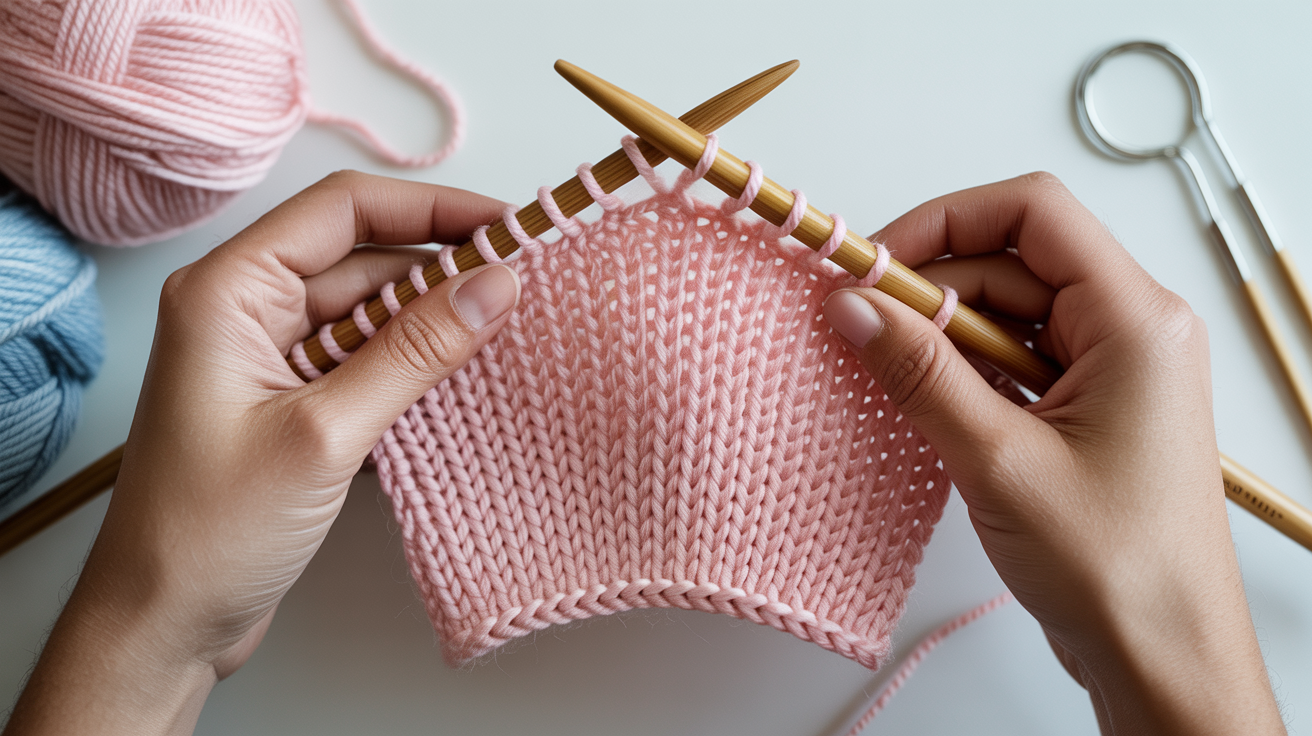
Before you start, make sure you have:
- A pair of knitting needles (US size 7 or 8 works well for beginners)
- Worsted-weight yarn in a light color (easier to see your stitches)
- A cast-on row of 10–15 stitches to practice on
The single most important difference between purling and knitting: the working yarn lives in FRONT of your needles when you purl. In knitting, you hold the yarn behind. Forgetting this is the most common beginner mistake, so it's worth saying twice, yarn in front, always, for every purl stitch.
How to Do the Purl Stitch: Step by Step
Hold your needle with the stitches in your left hand, and the empty needle in your right. Your working yarn should be hanging in front of the needles, between you and the work.
- Bring the yarn to the front. If it isn't already there, bring the working yarn between the tips of your needles so it hangs in front of your work.
- Insert the right needle into the first stitch from right to left. Slide the tip of the right needle into the front of the stitch on the left needle, entering from the right side and exiting through the left. The right needle tip will point away from you. (This is the opposite of the knit stitch, where the needle enters left to right.)
- Wrap the yarn counterclockwise around the right needle. With the yarn still in front, bring it up and over the right needle tip, wrapping it counterclockwise (from right to left, going over the top).
- Pull the new loop through the stitch. Carefully draw the right needle, and the new loop of yarn sitting on it, back through the original stitch. The right needle tip will move toward you as you do this.
- Slip the old stitch off the left needle. Nudge the original stitch off the tip of the left needle. You now have one new purl stitch sitting on the right needle.
Repeat steps 1–5 across the row. At the end, swap needles (the full needle goes to your left hand, the empty one to your right) and you're ready for the next row.
A Quick Tip on Tension
New knitters often purl tighter than they knit, which creates uneven fabric. After you pull the new loop through, give the yarn a gentle, consistent tug, not hard, just enough to snug the stitch. Aim for the same tension you use for knit stitches. It takes a few rows to find your rhythm, and that's completely normal.
Knit and Purl Together: Making Stockinette
Stockinette is the first "real" fabric most beginners make, and it only requires two moves: knit one row, purl one row.
Here's the pattern:
- Row 1 (right side): Knit across all stitches.
- Row 2 (wrong side): Purl across all stitches.
- Repeat rows 1 and 2.
The knit rows build the smooth, V-shaped surface you see on the front of a T-shirt or basic sweater. The purl rows sit on the back and look like a series of ridges or bumps.
One thing to watch: stockinette curls at the edges. This is normal, it's the nature of the stitch. For flat items like dishcloths or scarves, a border of garter stitch (knit every row) on all four edges keeps the fabric flat. For garments, seaming or finishing handles the curl.
Garter Stitch vs. Stockinette
If you knit every single row without ever purling, you get garter stitch, a squishy, reversible fabric with horizontal ridges. It's great for scarves and beginner projects because it lies flat. Stockinette requires that alternating knit-purl rhythm, but it produces a thinner, drapier fabric that's used in most wearable items.
Both are worth knowing. Garter is easier; stockinette is more versatile.
Common Purl Mistakes (and How to Fix Them)
Even careful beginners run into the same handful of snags. Here's what to watch for.
Yarn in the Wrong Place
If the yarn is behind your work when you try to purl, you'll accidentally add an extra loop to the needle, a stitch you didn't mean to make. Before each purl stitch, glance down and confirm the yarn is hanging in front. If you catch an accidental extra loop at the end of the row, you'll count more stitches than you started with. Just drop the extra loop off the needle and carry on.
Inserting the Needle the Wrong Way
The right needle goes into the stitch from right to left for a purl. If you insert it left to right (the knit direction), you'll twist the stitch. Twisted stitches aren't disasters, but they tighten up and look different from their neighbors. If your fabric looks uneven in spots, check your needle entry direction.
Splitting the Yarn
If your needle tip catches individual plies of the yarn instead of going cleanly through the stitch, it splits the strand. This is usually a tension issue, if the stitches on your left needle are very tight, they're hard to enter cleanly. Try keeping your stitches a bit looser, or work with your needle slightly closer to the tip of the left needle so there's more room to maneuver.
Dropping a Stitch
A dropped stitch slides off the needle and begins to unravel. If it just happened, stay calm, slip the loop back onto the left needle (making sure it's oriented correctly, with the right leg of the loop in front) and carry on. If it's already run down a row or two, a crochet hook can rescue it. This is worth learning early; every knitter drops stitches.
Once you're comfortable with knit and purl, you can learn how to bind off to finish your first real swatch cleanly.
Frequently Asked Questions
Why does my purling feel so much harder than knitting?
Purling feels awkward at first because your hands have to work in an unfamiliar direction. The right needle tip moves toward you instead of away, and managing the yarn in front takes some adjustment. Most knitters find purling a bit clumsy for the first hour or two, then it becomes automatic. Give it a full practice session before deciding it's difficult, the muscle memory builds fast.
Is purling the same as knitting backwards?
Essentially, yes. A purl stitch is structurally the same loop as a knit stitch, just formed from the opposite side. When you look at the back of a knit stitch, you're seeing a purl, and vice versa. Some experienced knitters actually purl by "knitting backwards", working right to left without turning the needle, but that's an advanced shortcut, not a technique beginners need to worry about.
What does it mean when a pattern says "purl-wise"?
Purl-wise means to insert the needle from right to left, as if you were about to purl, but without actually wrapping and pulling through. You'll see "slip purl-wise" in patterns, which just means slide the stitch from one needle to the other in the purl direction. It keeps the stitch untwisted.
Why is my stockinette curling up at the edges?
Stockinette curls because the knit and purl stitches have different tensions and pull in opposite directions. The top and bottom edges roll toward the knit (right) side; the left and right edges roll toward the purl (wrong) side. This is physics, not a mistake. Add a border of garter stitch (2–4 rows at top and bottom, 2–4 stitches on each side knitted every row) to keep flat pieces from curling.
How do I know which row to knit and which to purl in stockinette?
Look at the side facing you. If you see smooth V-shaped stitches, you're looking at the right side, knit this row. If you see bumpy horizontal ridges, you're looking at the wrong side, purl this row. After a few repeats this becomes second nature, and you'll read your fabric without thinking about it.