Crochet Basics
How to Turn Your Work and Make Turning Chains
Learn how to make a turning chain and turn your crochet work at the end of every row. Includes a stitch height table and beginner tips.
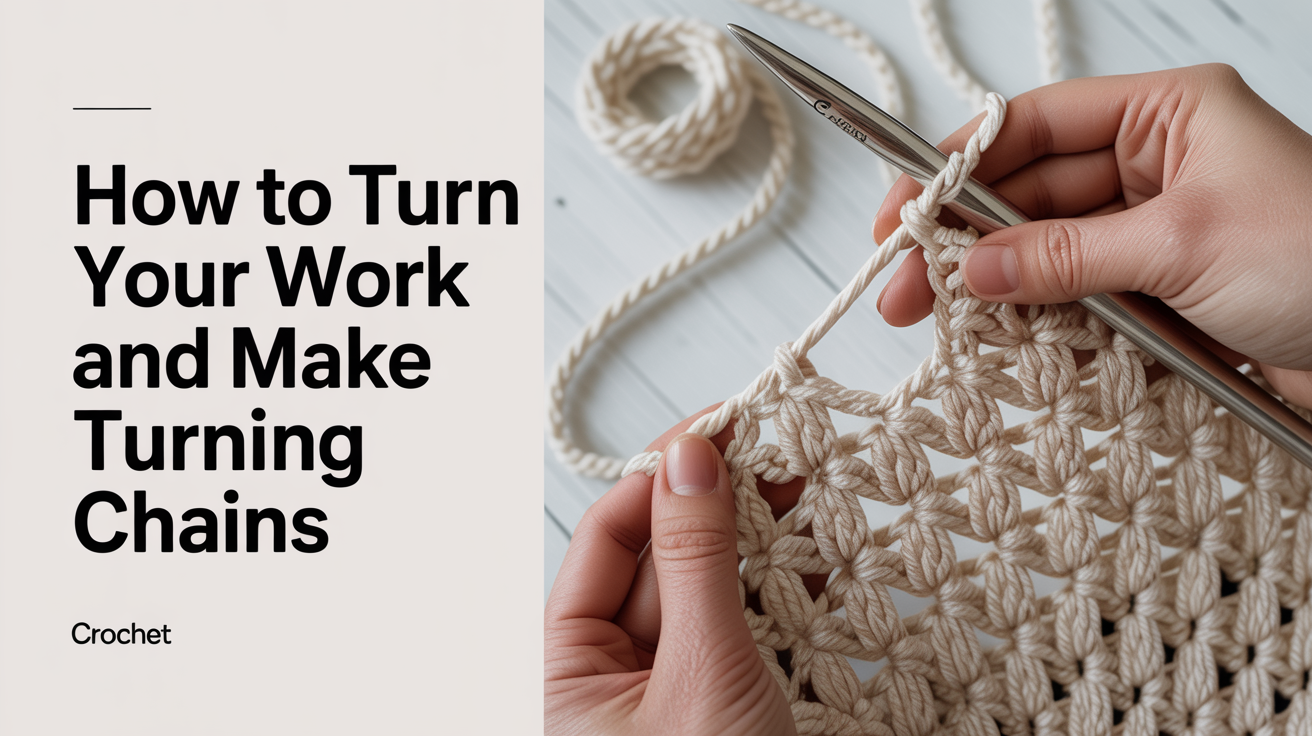
When you reach the end of a crochet row, two things need to happen before you can start the next one: you make a few chain stitches (called a turning chain) to bring your hook up to the right height, then you flip your work over so you can crochet back across it. That's it. But if no one has explained why you do this, the instruction "ch 3, turn" in a pattern can feel like it came out of nowhere, and skipping it (or doing it wrong) leads to wavy edges and rows that look uneven.
This guide covers both steps in plain language. Whether you're working through your first crochet project or you got stuck mid-pattern and need a clear explanation, you'll find what you need here.
At a Glance
- A turning chain raises your hook to the correct height for the next row's stitch, and it's worked right before you flip the piece.
- The chain count depends on the stitch: 1 for single crochet, 2 for half double, 3 for double, 4 for treble.
- For single crochet, the turning chain almost never counts as a stitch; for double and treble crochet, it usually does.
- Rotate consistently in the same direction every row so your fabric doesn't twist.
- A turning chain that's too tight will pucker the edge; one that's too loose will leave a sloppy gap.
- US and UK stitch names shift by one level, so always confirm which terminology system your pattern is using before counting chains.
What Is a Turning Chain and Why Does It Matter
A turning chain (often written as t-ch or simply noted as "ch 2" or "ch 3" at the end of a row) is a small set of chain stitches you work before flipping your piece and starting a new row. Its job is to raise your hook and working yarn to the correct height for the stitches you're about to make.
Every crochet stitch has a different height. A single crochet (sc) is short; a treble crochet (tr) is quite tall. If you tried to start a row of double crochets (dc) from the base of the row without climbing first, you'd be pulling your yarn at an awkward angle and the edge would pull in. The turning chain is what keeps your side edges straight and your fabric flat from row to row.
Think of it as a small staircase that lets you climb to the right floor before you start walking down the hall.
How Many Chains to Make: Turning Chain Heights by Stitch
The number of chains you need depends on which stitch you're using. Here's a quick reference for the four most common stitches, using the standard abbreviations from the Craft Yarn Council's crochet abbreviations master list, along with their UK equivalents:
| Stitch (US) | Abbreviation | Turning Chain | UK Name |
|---|---|---|---|
| Single crochet | sc | 1 chain | Double crochet (dc) |
| Half double crochet | hdc | 2 chains | Half treble (htr) |
| Double crochet | dc | 3 chains | Treble (tr) |
| Treble crochet | tr | 4 chains | Double treble (dtr) |
If you're reading a UK pattern, stitch names shift by one level compared to US terminology, a mapping the Craft Yarn Council also documents in its US/UK/Canada term comparison. The turning chain counts stay the same, but make sure you know which system your pattern uses before you start, because the differences can throw off your whole row. A US pattern calling for "dc" and a UK pattern calling for "dc" are not the same stitch: the US double crochet matches the UK treble, while the UK's "double crochet" is what Americans call single crochet.
Some patterns, especially modern US ones, call for a ch 2 instead of ch 3 for double crochet rows. This is a deliberate choice by the designer, not an error. If your pattern says "ch 2, turn" for dc rows, follow that instruction. The shorter chain sits flatter against the edge for some crocheters.
Does the Turning Chain Count as a Stitch
This is one of the most common points of confusion for new crocheters, and it comes up because the answer depends on which stitch you're using.
For single crochet: the turning chain of 1 almost never counts as a stitch. You'll work your first sc into the first actual stitch of the row, right at the base of where you turned.
For double crochet and treble crochet: the turning chain often does count as the first stitch of the row. This means you skip the stitch directly below the turning chain and work your second dc into the next stitch along.
Your pattern should tell you which approach it uses. Look for phrases like "ch 3 (counts as first dc)" or "ch 1, turn, sc in first st." If the pattern doesn't specify, sc patterns almost always treat the turning chain as a non-stitch, while taller stitch patterns more often count it.
Getting this right matters for your stitch count. If you work into the base of a turning chain that counts as a stitch, you'll add an extra stitch every row and your fabric will gradually widen; over 10 rows, a single extra stitch per row can widen a swatch by an inch or more depending on your gauge. Starting with a solid foundation chain and counting carefully from the beginning makes it much easier to spot these problems early.
How to Turn Your Work: Step by Step
Turning is a quick move once you see it broken down clearly. Here's the sequence at the end of any row:
- Work your last stitch of the row as normal.
- Make the number of turning chains your stitch requires (see the table above).
- Rotate your work toward you, or away from you if that feels more natural. Hold the hook in your dominant hand and let the fabric pivot in your other hand.
- The side that was facing away from you is now facing you.
- Begin working back across the row, inserting your hook into the stitches along the top of what you just made.
That's the whole move. You'll repeat it at the end of every row for as long as the pattern calls for flat (back-and-forth) crochet.
A few things worth noting:
- There's no single correct direction to turn. Most people rotate toward themselves (counterclockwise when looking down at the work), but either direction works as long as you stay consistent throughout your project.
- The turning chain can feel tight and pull at the edge if you chain under tension. Try to keep those chains a little looser than your regular stitches.
- If your edges are buckling inward, your turning chains are probably too tight. If they're flaring outward, check whether you're accidentally adding extra stitches at the start of rows.
Common Mistakes and How to Fix Them
Even after the concept clicks, a few small habits can cause problems row after row. Here's what to watch for:
Skipping the turning chain entirely. Without it, your hook can't reach the height of the new row, and your edge stitch will look different from the rest. Always make the chains before you turn.
Working into the turning chain when you shouldn't. For sc rows, if you treat the ch 1 as a stitch and work into it, you'll add an extra stitch. Count your stitches at the end of each row until the habit becomes automatic.
Forgetting to turn at all. This sounds obvious, but it happens. If you find yourself working in the same direction as the last row, you've likely started working in the round by accident. Most flat patterns require the turn to keep the work going back and forth.
Losing the last stitch of a row. If your stitch count keeps dropping by one, you may be skipping the final stitch before the turning chain of the previous row. That stitch is there and counts, even if it's snug against the edge.
If you're still building comfort with the basic stitch, practicing single crochet on a simple swatch while adding the turn after every row will make the motion feel automatic quickly. A 20-stitch swatch worked back and forth for ten rows is enough to get the pattern into your hands. If you want structured lessons beyond swatch practice, the Crochet Guild of America runs a certified teaching program and classes aimed at exactly this stage of learning.
The Turning Chain Gap: A Known Finishing Complaint
Once you're comfortable with the basic mechanics, you may notice a small hole or loose loop sitting right next to the turning chain on double crochet and treble crochet rows. This is a well-documented quirk, not something you're doing wrong.
The turning chain is meant to stand in for a full stitch, but a chain and a double crochet aren't actually the same shape. A dc has a solid post; a chain is just a series of loops. The mismatch shows up as a slightly larger gap at the edge than you'd get between two regular stitches.
A few common fixes, in order of how often crocheters reach for them:
- Work into the correct loop. Skipping into the wrong loop of the first stitch is the single most common cause of an oversized edge gap. Double-check you're working into the top of the stitch, not around the whole post.
- Try a "standing" or "chainless" start. Instead of a turning chain, some crocheters begin the row with a stitch worked directly, sometimes called a standing double crochet or a foundation-style start. This skips the chain-versus-stitch mismatch entirely, at the cost of a slightly different look you'll want to practice on a swatch first.
- Downsize just the turning chain. As mentioned above, working the turning chain one hook size smaller tightens it just enough to close the visual gap without changing the rest of your gauge.
None of these are mandatory. Plenty of finished projects use a plain ch-3 turn and look fine once blocked; this is a refinement worth knowing about once the basic turn feels automatic, not something to worry about on your first swatch.
Frequently Asked Questions
Why does my turning chain look looser than the rest of my stitches?
Chain stitches are often slightly looser than the stitches around them, which is normal. If the difference is noticeable, try going down one hook size just for the turning chains, then switching back to your main hook for the row. Some crocheters do this automatically when working with taller stitches.
Can I use a stitch marker to keep track of the turning chain?
Yes, and it's a good habit when you're learning. Place a locking stitch marker in the top of the last real stitch of a row before you turn. This marks exactly where your final stitch of the next row should land, so you don't skip it or accidentally work into the turning chain.
My edges keep getting longer or shorter row by row. What's going wrong?
Most likely you're either adding a stitch at the start of rows (by working into a turning chain that doesn't count as a stitch) or losing one at the end (by skipping the last stitch before the previous row's turning chain). Count your stitches at the end of every row and compare to your starting count until the numbers stabilize.
Does the turning chain change if I switch stitches partway through a pattern?
Yes. The turning chain is based on the stitch you're about to work in the new row, not the one you just finished. If a pattern shifts from sc rows to dc rows, you'd use the dc turning chain count (ch 3, typically) at the start of the first dc row, regardless of what came before.
What if my pattern doesn't mention a turning chain at all?
Look at which stitch the next row uses, then apply the standard chain count from the table above. Some patterns assume you know this and leave it out. Once you've worked with each stitch a few times, you'll supply the turning chain automatically without needing to look it up.
Do I need a taller turning chain for extended stitches like the extended double crochet?
Extended stitches (marked "ext" or "x" in some pattern shorthand) add an extra step to the base stitch, which usually means the standard turning chain from the table is a touch short. Check your pattern's gauge swatch: if your edge is pulling in noticeably on rows of an extended stitch, add one extra chain to that row's turning chain and see if the edge straightens out.