Getting Started
Left-Handed Knitting and Crochet: A Beginner's Guide
Left-handed? You can knit and crochet just fine. This guide covers tool hold, mirrored technique, and tips for getting your first stitches right.
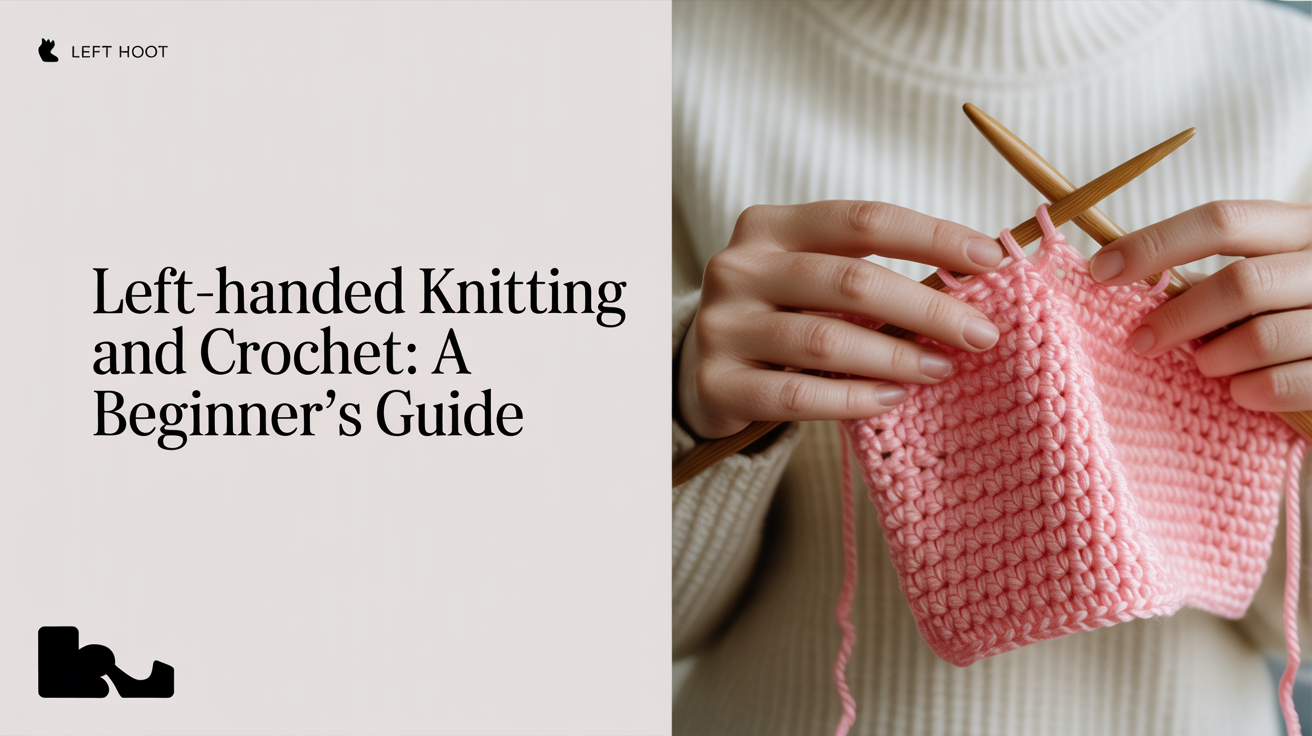
If you are left-handed and have tried to follow a knitting or crochet tutorial only to spend the first ten minutes staring at someone else's hands doing the exact opposite of what yours want to do, you are not alone. Most video and written instructions are made by right-handed crafters for right-handed audiences, and the mirroring problem is real. The good news is that left-handed knitting and left handed crochet are both completely learnable, and the finished fabric looks identical to right-handed work. The stitches are the same; only the direction changes.
Before you cast on or chain up, it helps to understand that "left-handed" in this context means you hold your working yarn and do most of the action with your left hand, while the right hand plays the steadying role. If you have been picking up a hook or needles and everything feels awkward, that is likely the fix. Some lefties do adapt to the right-handed method over time, but there is no reason you have to. Both approaches produce the same results.
How Left-Handed Crochet Works
In standard right-handed crochet, the hook sits in the right hand and the work travels from right to left. In left handed crochet, the hook moves to the left hand and the work travels from left to right. That is the whole change.
Here is what that looks like step by step for a basic chain (ch):
- Make a slip knot and place it on the hook, held in your left hand.
- Hold the tail of the yarn with your right hand, and drape the working yarn (the yarn going back to the ball) over your right index finger to control tension.
- With your left hand, catch the working yarn from underneath with the hook throat and pull it through the loop on the hook.
- Repeat to form a chain.
For a single crochet (sc), insert the hook into the target stitch, catch the yarn from underneath (yarn over, or YO), pull up a loop so you have two loops on the hook, YO again, and pull through both loops. Every subsequent stitch follows the same left-to-right logic.
One thing to watch: when you read patterns, any instruction about working into the right edge or the left edge of a piece will be reversed for you. A pattern that tells a right-handed crocheter to seam along the right side will mean the left side for you. It becomes second nature quickly, but flag it when you first sit down with a new pattern.
For more detail on setting up your hands before you start, see how to hold knitting needles and a crochet hook.
How Left-Handed Knitting Works
Left-handed knitting tends to feel more varied because there are a few legitimate methods lefties use, not just one agreed standard.
Mirror-image knitting is what most people mean when they say "left-handed knitting." You cast on from the right needle to the left, and you knit from right to left across a row. Your working needle is in your left hand doing the active inserting and wrapping, while your right needle holds the stitches waiting to be worked. This is a direct mirror of the right-handed method and is the most intuitive starting point for most lefties.
Continental knitting is another option that some left-handed beginners find comfortable without any mirroring. In continental style, you hold the working yarn in the left hand and "pick" it with the needle rather than throwing it. Because the left hand is already doing the main tension work, many left-handed people adapt to continental knitting with less frustration than to the English throw method.
Combination knitting wraps yarn in a non-standard direction on certain stitches and is sometimes discovered by lefties independently. It can produce neat, even fabric, but patterns need small adjustments. If you are just starting out, mirror-image or continental are the cleaner paths.
For your very first cast-on, the long-tail cast-on works well mirror-imaged: hold both yarn ends in your right hand, and use your left needle to do the scooping motions. It takes a few minutes to feel natural, but the setup muscle memory arrives sooner than you expect.
Setting Up Your Tools
Your tools are the same whether you are left- or right-handed. You do not need left-handed hooks or special needles. A standard crochet hook, a pair of straight or circular knitting needles, and a skein of smooth worsted-weight yarn are all you need to practice.
Smooth yarn in a light color is especially helpful when you are learning, because you can actually see each stitch without squinting. Avoid anything fuzzy or heavily textured for the first few practice sessions; those yarns hide the stitches and make it harder to count.
A few tool tips for beginners:
- Hook size: A 5 mm (US H/8) crochet hook paired with worsted-weight yarn is a reliable starting combination. The stitches are large enough to see and small enough to keep your work from getting sloppy.
- Needle size: US 7 or US 8 (4.5 or 5 mm) straight needles with the same worsted yarn give you a similar learning experience for knitting.
- Stitch markers: These snap onto your needle or into a chain and mark where a row begins or a stitch pattern repeats. They cost very little and save a lot of counting.
For a full rundown of what to buy, knitting and crochet supplies every beginner needs covers all the basics without overcomplicating it.
Reading Patterns and Charts as a Lefty
This is where left-handed beginners sometimes hit a wall, and it is worth spending a few minutes on it before your first real project.
Most written patterns use row-by-row instructions that do not specify a direction, only what stitch to make. For those, you are fine with no adjustments beyond being aware of any directional language ("right side," "left edge," etc.) that you will need to flip.
Charts are more of a puzzle. In standard right-handed knitting, a flat chart is read from bottom right to top left, alternating directions each row. Left-handed knitters working flat read the opposite: start bottom left, move right, then on the next row start from the right side again. If you are working in the round, you will read every round right to left, which is actually simpler than the flat alternation.
Crochet charts are read in a similar mirrored way. A right-handed crocheter reads flat crochet charts right to left on odd rows and left to right on even rows. As a left-handed crocheter, you flip that.
A practical tip: print a chart, hold it up to a mirror or flip it horizontally on your phone, and work from that image. It takes the translation step out of the equation entirely.
Not sure whether knitting or crochet suits you better for a first project? Knitting vs. crochet: which should a beginner learn first? walks through the trade-offs.
Your First Practice Project
The simplest way to put left-handed knitting or crochet into practice is a small square. It is not glamorous, but a 6-inch square teaches you every fundamental motion without locking you into a long project.
For a crochet square:
- Chain 16.
- Single crochet into the second chain from the hook and into each chain across (15 sc).
- Chain 1, turn, and sc across the top of each stitch.
- Repeat until your square is roughly as tall as it is wide.
- Fasten off and weave in your ends with a tapestry needle.
For a knitting square:
- Cast on 20 stitches.
- Knit every stitch of every row (this makes garter stitch, which lies flat on its own).
- Bind off when the piece is roughly square.
Both of these take under an hour, and the result gives you something tangible to hold while you decide what you want to make next.
Frequently Asked Questions
Can I follow any standard knitting or crochet pattern if I am left-handed?
Yes, with minor adjustments. Most written instructions do not specify direction explicitly, so you follow the same stitch instructions and simply mirror the direction of travel. Directional language like "right side facing" or "seam along the left edge" will need to be flipped, but after a project or two you will do this automatically.
Do I need to buy special left-handed crochet hooks or needles?
No. Standard hooks and needles work fine for left-handed crafters. The tool does not know which hand is holding it. If a retailer markets "left-handed hooks," the hook itself is the same; it is just marketing.
Is left-handed knitting or crochet slower than right-handed?
In the early stages, everyone is slow, regardless of dominant hand. Speed comes from repetition. Many experienced left-handed knitters and crocheters work at the same pace as right-handed crafters once the motions are embedded in muscle memory.
Why do some left-handed people just learn the right-handed method?
Some find it easier to mirror what they see in tutorials directly, especially if they start learning from in-person classes or live video where flipping the image is not possible. There is no wrong answer. If right-handed feels comfortable to you, go with it. If it feels forced, the mirrored approach is a legitimate and equally valid path.
My tension is uneven. Is that a left-handed problem?
Tension issues are universal in the first few weeks of learning; they are not specific to lefties. The most common cause is holding the yarn too loosely or gripping it too tightly out of concentration. Try consciously relaxing your hands between stitches, and keep practice sessions short enough that fatigue does not set in. Even tension usually arrives on its own once your hands stop thinking so hard about the motions.