Knitting Basics
Stockinette and Garter Stitch: A Beginner's Guide
Learn how to knit stockinette stitch and garter stitch from scratch, understand the differences, and know when to use each one.
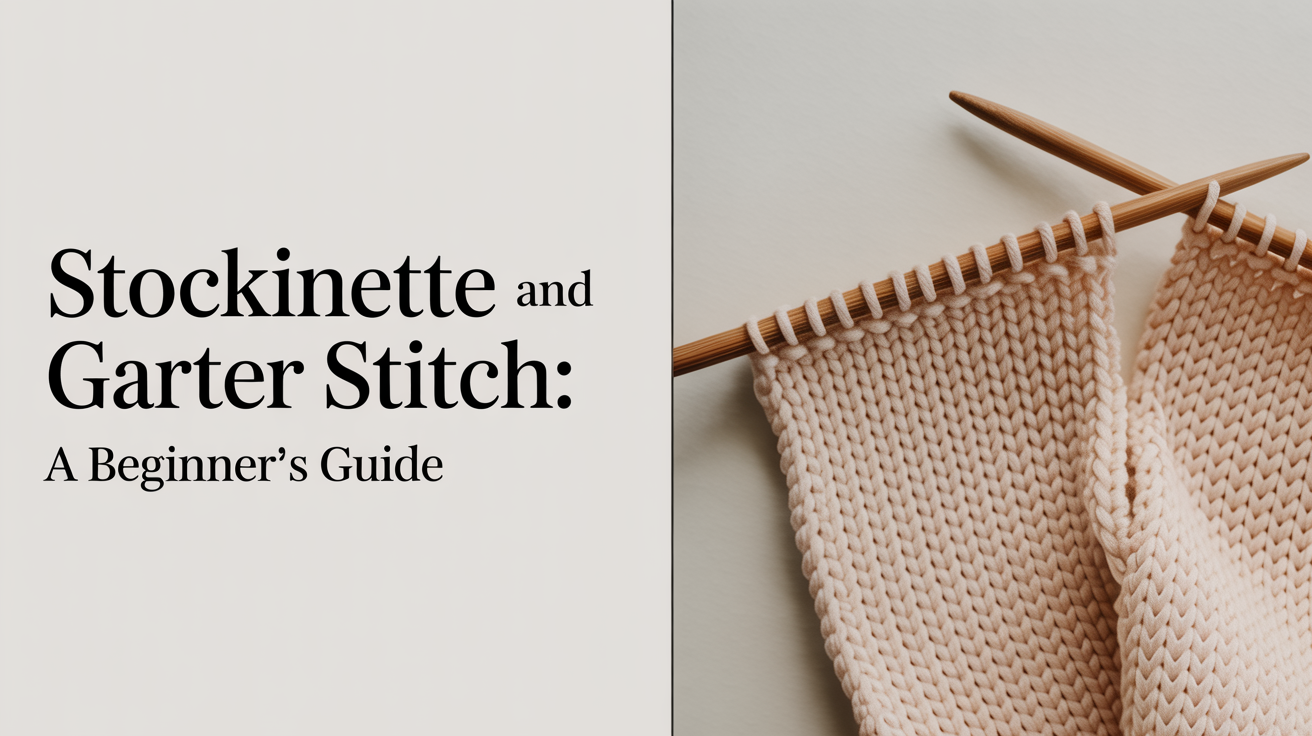
If you have learned your first two stitches, the knit and the purl, you already know everything you need to make the two most common knitting fabrics: garter stitch and stockinette stitch. Both show up constantly in beginner patterns, and understanding what each one looks like, how it behaves, and when to reach for it will save you a lot of confusion as you work through your first projects.
Garter stitch uses only knit stitches on every row. Stockinette stitch alternates a knit row with a purl row. That single difference produces two fabrics that look and act in completely different ways, and knowing that from the start makes pattern instructions much easier to follow.
At a Glance
- Garter stitch: knit every row. It lies flat, looks the same on both sides, and is forgiving of uneven tension.
- Stockinette stitch (St st): knit one row, purl the next. It's smooth on the right side, bumpy on the wrong side, and curls at the edges.
- Garter is thicker and shorter per row than stockinette worked over the same number of rows, so gauge doesn't transfer between them.
- Reach for garter on scarves, dishcloths, and non-curling borders; reach for stockinette for the main body of sweaters, hats, and socks.
- Curling on stockinette is normal fabric behavior, not a mistake, and it's usually solved with a garter or ribbed border.
- To count rows fast, count garter ridges and multiply by two.
What Is Garter Stitch
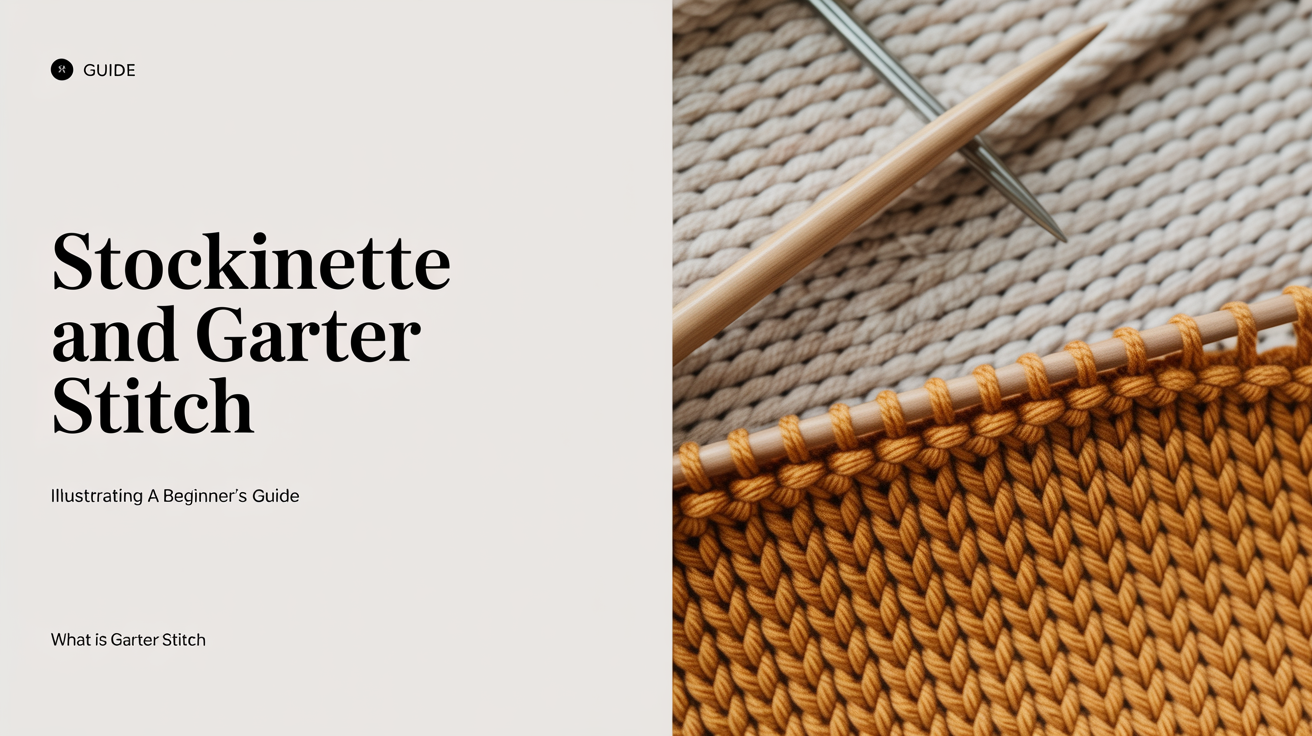
Garter stitch is produced by knitting every single row. When you flip your work at the end of a row and knit across again, the fabric builds up in horizontal ridges. Each ridge is made of two rows, so if you have knitted 20 rows, you will count 10 ridges. The fabric is the same on both sides, which makes it reversible, a useful property for scarves, dishcloths, and blanket borders.
Garter stitch also lies flat. Because the ridges pull in slightly, the fabric does not curl at the edges. For this reason it appears in borders and button bands where curling would be a problem. The finished texture has a gentle, bumpy look that can feel homey and casual. It is also a forgiving fabric for tension work because the ridges hide slight inconsistencies in your stitches.
In terms of dimensions, garter stitch tends to be thicker and shorter than stockinette worked over the same number of rows. A garter swatch of 20 rows in worsted weight typically measures around 3 to 3.5 inches tall, while the same 20 rows in stockinette usually run closer to 4.5 to 5 inches, because the ridges compress the rows vertically. If a pattern calls for garter stitch gauge, measure it separately rather than assuming your stockinette gauge carries over.
What Is Stockinette Stitch
Stockinette stitch (abbreviated St st in the Craft Yarn Council's standard knitting abbreviations) is formed by alternating a right-side knit row with a wrong-side purl row. The result is a smooth, flat fabric on the right side and a bumpy fabric on the wrong side. The smooth side is called stockinette; the bumpy side is sometimes called reverse stockinette, and some patterns use it intentionally as the public face.
This is the fabric you see in most commercial knitwear: t-shirts, hats, socks, and sweater bodies are usually worked in stockinette or a variation of it. The stitches line up in tidy vertical columns called wales, and you can see a slight V shape in each stitch when you look closely at the right side.
Stockinette has one well-known quirk for beginners: the edges curl. The top and bottom of a flat stockinette piece curl toward the right side, and the left and right edges curl toward the wrong side. This is not a mistake in your knitting. It is a structural property of the stitch, caused by the way each row's yarn tension pulls slightly differently on the front and back faces of the fabric. Patterns deal with it by adding a border in a non-curling stitch (garter or ribbing), by seaming the edges into a garment, or by blocking the finished piece. If you are swatching in stockinette and your rectangle is rolling itself into a tube, that is normal.
Before you start a stockinette project, it helps to be comfortable with how to knit the knit stitch and how to purl, since you will be switching between them every row.
How to Knit Each Stitch Pattern
Garter stitch requires no special setup. Once you have cast on your stitches, knit every row until the piece is as long as you need. Flip your work, knit back. That is it. The pattern row repeat is simply: knit all stitches. If you are working in the round on circular needles, garter stitch in the round is produced by alternating one knit round with one purl round, because working in the round means your right side is always facing you.
Stockinette stitch when worked flat:
- Cast on the number of stitches the pattern specifies. See how to cast on in knitting if you need a refresher.
- Row 1 (right side): Knit all stitches across.
- Row 2 (wrong side): Purl all stitches across.
- Repeat rows 1 and 2 until the piece reaches the required length.
A pattern will usually confirm which side is the right side in the first few instructions, or it will note "RS" and "WS" next to the row instructions. If you lose track, look at your work: the smooth V-stitch side is the right side, and the bumpy side is the wrong side.
When working stockinette in the round, you knit every round. Because you always face the right side in the round, you never need to purl to produce the smooth fabric. This is why knitting in the round can feel faster for stockinette projects like hats and yokes.
Stockinette vs Garter at a Glance
| Garter stitch | Stockinette stitch | |
|---|---|---|
| How it's made | Knit every row | Knit 1 row, purl 1 row |
| Look, right side | Ridged, same both sides | Smooth Vs |
| Curls at edges? | No | Yes, top/bottom and sides both |
| Row height (20 rows, worsted) | About 3–3.5 in | About 4.5–5 in |
| Reversible? | Yes | No (right side ≠ wrong side) |
| Typical use | Scarves, dishcloths, borders | Sweater bodies, hats, socks |
| In the round | Alternate knit round / purl round | Knit every round |
Stockinette vs Garter: Which One to Choose
The choice usually comes down to three factors: the look you want, whether you need flat edges, and what the pattern asks for.
Choose garter stitch when:
- You want a fabric that lies flat without extra effort
- You are making a dishcloth, washcloth, or simple scarf
- You are adding a border to keep stockinette from curling
- You only want to practice knit stitches for now
Choose stockinette stitch when:
- You want a smooth, fabric-like surface
- You are following a sweater, hat, or sock pattern
- The pattern specifies St st
- You are ready to practice purling and switching between the two stitches every row
It is also common to combine them in a single piece. Many beginner scarves use several rows of garter at each end and stockinette in the middle. Sweater patterns often place garter or seed-stitch borders along hems and cuffs to prevent the stockinette body from rolling. Extension programs that teach hand knitting to new sewers and fiber crafters, including Colorado State University Extension's 4-H heritage arts curriculum, cover blocking and finishing as a core skill precisely because of this kind of edge-and-border planning.
Common Beginner Problems
My garter stitch looks uneven. Uneven tension is the usual reason. Knitting is a motion that most beginners tighten up over time as the hands relax. Practice helps more than adjusting needle size. If some rows are noticeably tighter than others, try to keep a consistent grip on the working yarn and avoid pulling it too tight after completing each stitch.
My stockinette is curling. This is expected behavior. If you are swatching, just note the dimensions before it curls and continue. If you are making a finished object and the curl bothers you, add a few rows of garter at the cast-on and bind-off edges and a few stitches of garter at each side edge. Even 3 to 5 stitches of garter at each side edge is usually enough to stop the sides from rolling on a typical worsted-weight piece.
I lost track of which side is the right side. Look at your work. The smooth, V-stitch face is the right side of stockinette. If you started the piece correctly, the tail from your cast-on is usually at the bottom-right corner when the right side faces you, though this depends on your cast-on method.
I mixed up rows and accidentally knitted a purl row. Check the stitches on the needle. On a knit row, the bump of the stitch faces away from you; on a purl row, the bump faces you. If you have just knitted a row when you should have purled, you will see that the bumps are all on the wrong side. Depending on how far along you are, you can either rip back the mistake row or continue, knowing that it will show as a small ridge but probably will not ruin the project.
Frequently Asked Questions
What does St st mean in a knitting pattern?
St st is the common abbreviation for stockinette stitch. It means you alternate knit rows and purl rows. Some patterns spell it out as "stockinette stitch" or "stocking stitch" (the British term), but the fabric is the same in all cases.
Why does my stockinette curl but my garter stitch does not?
Garter stitch produces ridges that have roughly equal tension pulling both horizontally and vertically, so the fabric stays flat. Stockinette stitches pull more in one direction on the right side and more in the other direction on the wrong side, which creates an imbalance that makes the edges roll. Adding a non-curling border or seaming the edges resolves this in finished projects.
Can I substitute one for the other in a pattern?
Not without adjusting the stitch count and possibly the needle size. Garter stitch and stockinette have different row gauges: garter is shorter per row because the ridges compress the fabric, and stockinette is taller per row. Swapping one for the other will change the finished dimensions, sometimes significantly, on the order of 25 to 30 percent taller for the same row count when you switch from garter to stockinette. If you want to make a substitution, check your gauge carefully and recalculate the row counts.
How do I count rows in garter stitch?
Count the ridges and multiply by two. Each visible ridge equals two knitted rows. If you see six ridges, you have worked twelve rows.
What is reverse stockinette?
Reverse stockinette is just the wrong side of a standard stockinette fabric. Some patterns use it as the public face deliberately because the bumpy texture has a different look. Technically you are still knitting and purling the same way; you just call the bumpy side the right side and treat it accordingly.
Does blocking behave differently on garter versus stockinette?
Yes. Because stockinette already carries a curl to correct, blocking does real structural work there, pinning the edges flat and letting the fibers relax into the corrected shape. On garter, blocking is mostly cosmetic since the fabric already lies flat; it will even out minor tension differences and soften the texture, but it won't be fixing a curl the way it does on stockinette.