Crochet Basics
Why Your Crochet Edges Aren't Straight (and How to Fix It)
Crochet edges going wavy or lopsided? Learn the most common causes of uneven edges and exactly how to fix them, stitch by stitch.
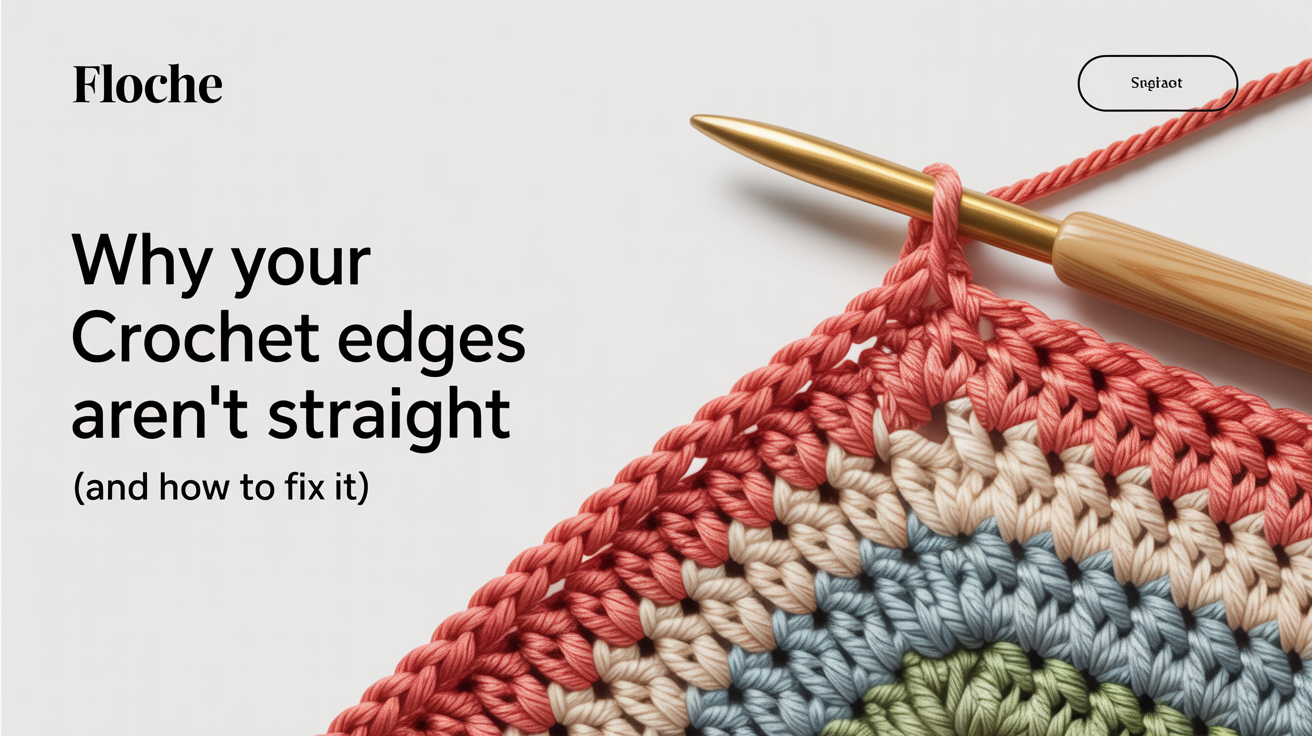
Crooked edges are one of the most common frustrations for new crocheters. You start a project with a tidy foundation chain, work a few rows, then look down to find the sides curving outward, pinching inward, or looking like a ruffled potato chip. The good news is that uneven crochet edges almost always come from one of a small handful of mistakes, and once you know what to look for, they are genuinely straightforward to fix.
This guide walks through each cause in plain language, shows you how to spot it on your own work, and gives you concrete steps to correct it going forward. If you are brand new to crochet, you may want to start with the basics in How to Crochet for Absolute Beginners first, then come back here when your edges start misbehaving.
The Most Common Culprit: Missing or Adding Stitches at the Edges
If your work is getting wider with every row, you are adding stitches. If it is narrowing, you are losing them. Both problems happen at the same two places: the very beginning of a row and the very end of one.
At the beginning of a row, the turning chain is the main trap. When you work a single crochet (sc), the turning chain is 1 chain tall. That chain does NOT count as a stitch in single crochet. After you turn your work, your first "real" stitch goes into the first stitch of the previous row, right next to the turning chain. Many beginners skip that stitch because the turning chain seems to be sitting right there, and skipping it feels natural. Skip it ten rows in a row and you lose ten stitches on one side.
At the end of a row, the matching trap is working an extra stitch into the turning chain from the previous row. If the pattern says the turning chain does not count as a stitch (standard for sc), then the turning chain at the top of the last row is NOT a stitch to work into. Crocheting into it anyway adds a stitch each row, which makes your piece fan out.
How to fix it:
- Before you begin each new row, count your stitches out loud and record the number. Your stitch count should match the number you cast on every single row.
- Place a stitch marker into the first and last stitch of each row so you can find them instantly when you turn.
- After turning, look at your work. You should see a "V" shape sitting right below the hook on each stitch. Work your first stitch into the first V at the edge, not into the turning chain.
The Turning Chain: When It Counts and When It Does Not
Different stitch heights use different turning chain lengths, and whether the turning chain counts as a stitch changes depending on the stitch.
| Stitch | Turning chains | Does it count as a stitch? |
|---|---|---|
| Single crochet (sc) | 1 chain | No |
| Half double crochet (hdc) | 2 chains | Sometimes (check pattern) |
| Double crochet (dc) | 3 chains | Usually yes |
| Treble crochet (tr) | 4 chains | Usually yes |
For beginners working in single crochet, the rule is simple: the turning chain does not count, so your first sc goes into the first stitch of the previous row. If you are following a pattern that uses double crochet, the turning chain usually does count as the first stitch, which means you skip the first stitch below it and work your first dc into the second stitch instead.
When a pattern is unclear, look for a note near the beginning that says something like "turning chain does not count as a stitch throughout." If there is no note, assume sc turning chains do not count and dc turning chains do.
Tension Problems That Warp Your Edges
Even if your stitch count is perfect, tension can pull your edges out of shape. Tight tension at the edges cramps them inward; very loose tension lets them spread.
Signs of a tension problem: The sides of your work feel stiffer or look tighter than the middle. Or the whole piece ripples and will not lie flat even after you tug it straight.
Why it happens: Many beginners grip the hook and yarn harder as they get to the edges of a row because they are trying to keep the work tidy. The result is that the edge stitches end up tighter than the center stitches.
What to do:
- Try to keep your grip consistent across the whole row. The yarn tension should feel the same at stitch 1 as it does at stitch 15.
- Work your stitches onto the widest part of the hook shaft, not just the narrow tip. This gives each stitch a consistent size.
- If you are a naturally tight crocheter, go up one hook size. The finished fabric will feel more relaxed and the edges are less likely to pull in.
- If you are working with slippery yarn (acrylic blends, cotton), wrap the yarn one extra time around your index finger to add light resistance without gripping harder.
How to Check Your Work as You Go
The best way to keep edges straight is to catch problems at row 3, not row 30. Two habits will help more than anything else.
Count every row. After you finish a row and before you turn, count all your stitches. Match that number against your starting count. If the count is off, rip back that row (a process sometimes called "frogging") and redo it. Ripping back one row is far less painful than ripping back twelve.
Use stitch markers at the edges. A simple locking stitch marker through the first and last stitch of every row takes about five seconds to move and removes all guesswork about where your edges are. You can use commercial stitch markers, a piece of scrap yarn tied in a loop, or a small safety pin.
Internal-link tip: if you are still getting comfortable forming individual stitches, working through How to Single Crochet for Beginners will help you lock in consistent stitch formation, which makes edge trouble much less likely from the start.
What to Do When Your Foundation Chain Is the Problem
Wavy edges can also come from the foundation chain itself being too tight or having the wrong number of chains. If the starting chain is tighter than the rest of your work, the bottom edge will pucker and the piece will taper toward the start.
To fix a tight foundation chain, try one of these approaches:
- Use a hook one size larger for the chain only, then switch back to your regular hook for row one.
- Work your foundation chain loosely on purpose, even if it looks a bit big. The stitches in row one will naturally tighten it up a little.
- Count your foundation chain carefully before starting row one. It is easy to lose count mid-chain. If you are making a 30-stitch base, mark every 10th chain with a stitch marker as you go so you do not have to count all 30 at once.
For a step-by-step walkthrough of making a clean foundation, see How to Make a Slip Knot and Foundation Chain.
Frequently Asked Questions
My crochet was straight for the first five rows, then suddenly got wider. What happened? This almost always means you started working into the turning chain by accident. It usually happens after you get a little comfortable and stop paying as close attention to where your hook is going. Place a stitch marker in the last real stitch of each row so you can see exactly where that row ends and the turning chain begins.
I counted my stitches and the number is right, but my edges still look wobbly. Why? A correct stitch count rules out adding or losing stitches, so the culprit is likely uneven tension. Try working a small swatch of 15 stitches over 10 rows just focusing on keeping a relaxed, consistent grip. If the swatch is still wobbly, your hook size might be wrong for the yarn; check your yarn label for the suggested hook range.
Will blocking fix uneven edges? Blocking (wetting the finished piece and pinning it flat to dry) can even out minor waviness, especially in natural fibers like cotton and wool. It will not fix a piece that has gained or lost many stitches over multiple rows, though. Those structural problems need to be corrected by ripping back and re-crocheting.
My edges are straight but the corners at the end of each row look lumpy. Is that normal? A little lumpiness at the turning point is normal, especially in single crochet. You can neaten it over time by keeping your turning chain loops the same size as your regular stitches and not pulling them too tight before you turn. The edge also tends to look cleaner once the piece is blocked or once you add a border.
How many rows should I crochet before checking if my edges are straight? Count your stitches after every row, without exception, for your first several projects. Once you have built the muscle memory and can feel when something is off, you can check every two or three rows. Never wait until a project is finished to check because undoing many rows of crochet is much harder than catching a problem early.